Is Moneta Instant Pro's Half-Price Coupon Worth It? Comparing Effective DD Room, Break-Even, and Monte Carlo Against Blueberry's Instant [Analysis]
※ This article is analysis/opinion, not investment advice. Prices and rules were measured on both firms' official checkout screens and help centers on September 10, 2026, and change frequently. Always confirm the terms on the official final screen before buying.
Moneta Funded has a 50%-off coupon running on its Instant Pro plan. $100K normally lists at $5,300, but it's $2,650 with the code. No evaluation phase — you go straight to a funded account, 88% profit split, and news trading is even allowed. On paper, that's an aggressive set of terms.
Is it worth buying? We put numbers on what the fee actually buys, lining it up against Blueberry Funded's instant plan — the other "no evaluation, funded from day one" option.
TL;DR: Even at half price, it's not that great a deal. Try $10K first
- The pricing trap first. Blueberry's
PRIME50(50% off) is Prime 2-Step only — it does not apply to Instant Elite or Instant Lite. The only code that works on the instant plans isBERRY15(15% off). The actual price for $100K is $2,380. - What the fee really buys is drawdown room. But the room is judged on the full account size while you only get to keep a fraction of what you earn from it, set by the profit split. We correct for this asymmetry with "effective DD room = account size × max DD% × profit split."
- At $100K, Moneta Instant Pro ($2,650) and Blueberry Instant Elite ($2,380) are close to even. Effective DD room is 2.66x vs. 3.36x in Blueberry's favor; break-even is 3.01% vs. 2.97% — essentially the same.
- At $10K the ranking flips. Moneta comes out to 2.82x, break-even 2.84%, versus Blueberry Instant Elite's 2.35x, break-even 4.25%. Blueberry gets cheaper at larger sizes, Moneta gets cheaper at smaller sizes — that's how the two firms have priced their plans.
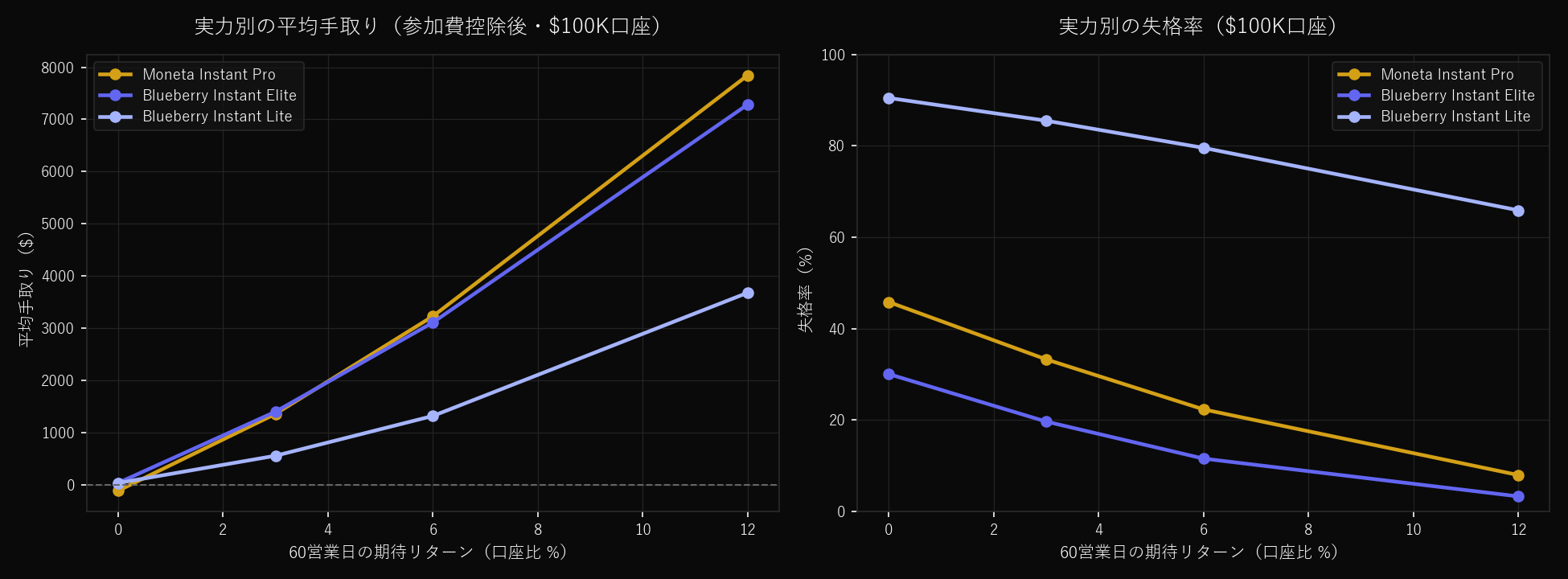
- In a 40,000-run Monte Carlo (60 trading days, 1% daily vol), Blueberry wins at small edges, Moneta overtakes it above roughly +6% edge. Blueberry's failure rate is lower at every skill level.
- Instant Pro's real cost isn't the price — it's the 4% daily profit cap. Hit it and you get auto-closed and locked out until the next day. After the 88% split, the effective payout cap is 3.52%; for $100K that means even a perfect day at the cap nets only $870 after subtracting the fee.
- Blueberry Instant Lite depends entirely on lot size. At the same lot size it hits the 4% DD / 2% daily limits and fails 90.5% of the time at zero edge. But cut the lot size in half and the failure rate drops to 22.4% with an average of +$2,004 — dominating the other two plans because the fee is under a quarter of theirs. In exchange, the 15% consistency check holds up the first payout for 62.7% of runs.
- The Monte Carlo does not model execution quality. The less slippage, the higher the realized edge for breakout- and news-style strategies — and since Moneta overtakes Blueberry above +6% edge, good execution tips the conclusion toward Moneta.
- Bottom line: "50% off" is not by itself a reason to buy. The list price is nearly double Blueberry's, so half price is what it takes to bring it level. If you buy, start with $10K and test the 4% daily cap and your execution quality with your own strategy first.
First: Blueberry's "50% off" does not apply to the instant plans
Before the comparison, let's settle the pricing assumptions — get this wrong and every conclusion downstream shifts.
Blueberry's site shows a banner across every page: PRIME50 FOR 50% OFF – FIRST TIME PURCHASE | PRIME30 FOR 30% OFF – EXISTING TRADERS. It looks like it applies to every plan, but entering PRIME50 at checkout on Instant Elite gets rejected with coupon "prime50" is not applicable to selected products". PRIME30, FLEX30, and PRIMEPASS were all rejected the same way.
Here's what we found testing every combination at checkout on September 10, 2026 (for $100K):
| Blueberry plan | List price | Code that worked | Actual price paid |
|---|---|---|---|
| Prime 2-Step | $812 | PRIME50 (50%) | $406 |
| Flex 1 Step | $835 | FLEX30 (30%) | $584.50 |
| 1-Step | $605 | BERRY15 (15%) | $514.25 |
| Instant Elite | $2,800 | BERRY15 (15%) | $2,380 |
| Instant Lite | $785 | BERRY15 (15%) | $667.25 |
The evaluation plans have half-off, the instant plans don't. That's Blueberry's pricing design. If you compare on the assumption that "50% off makes Blueberry cheaper," the actual checkout price will catch you off guard.
For reference, Moneta's TOKONATSU50 applied cleanly the same day on the Instant Pro checkout: $5,300 → $2,650, and $10K went from $500 → $250.
The premise: what this article compares
We're limiting this to "instant" plans that skip the evaluation phase and go straight to a funded account. The ranking changes depending on size, so we look at both $10,000 and $100,000.
| Option | List price ($10K / $100K) | Code | Discounted ($10K / $100K) | Max DD | DD type | Daily DD | Split | Daily profit cap |
|---|---|---|---|---|---|---|---|---|
| Moneta Instant Pro | $500 / $5,300 | TOKONATSU50 | $250 / $2,650 | 8% | Trailing | 4% | 88% | 4% (auto-close on hit) |
| Blueberry Instant Elite | $400 / $2,800 | BERRY15 | $340 / $2,380 | 10% | Trailing lock | None | 80% | None |
| Blueberry Instant Lite | $139 / $785 | BERRY15 | $118.15 / $667.25 | 4% | Trailing lock | 2% | 80% | None |
Both firms' DD is "trailing"
An easy thing to miss. Blueberry's help center's full Instant Elite guide says: "The maximum drawdown is 10% and trails up as your equity makes new highs. Once it reaches the initial balance, it stops there and is locked permanently thereafter." It's a trailing lock, not static. The same shape applies to Instant Lite's 4% and to Moneta Instant Pro's 8%.
You don't need to assume "trailing = worse." The line never goes above the initial balance, so the more profit you build, the closer it gets to behaving like a static DD. On a $10K Instant Elite account, once you touch +10% ($11,000), the line locks at $10,000, and from that point on it behaves exactly like an ordinary static DD: "breach the original balance and you fail."
What you do need to watch for is that the line moves on floating profit too. Just briefly marking a new high on an open, unrealized position is enough to lock it in. Strategies that let profit run and then pull back will see the line rise faster than expected.
1. Price per unit of DD room: correcting for the loss/profit asymmetry first
Thinking of the fee as "rent for the account" makes it hard to compare, so we reframe it as "how much room to lose, bought for how much." Naively, that's DD room = account size × max DD%.
But there's a catch. Drawdown is judged against the full account total, while what you actually keep is only the profit-split fraction. A $100K Instant Pro account lets you lose up to 8% ($8,000), but any profit earned using that room is only 88% yours to keep. Losses are measured on a 100% scale, profits shrink to 88%. If you divide room by price without correcting for this, plans with a lower profit split look unfairly good.
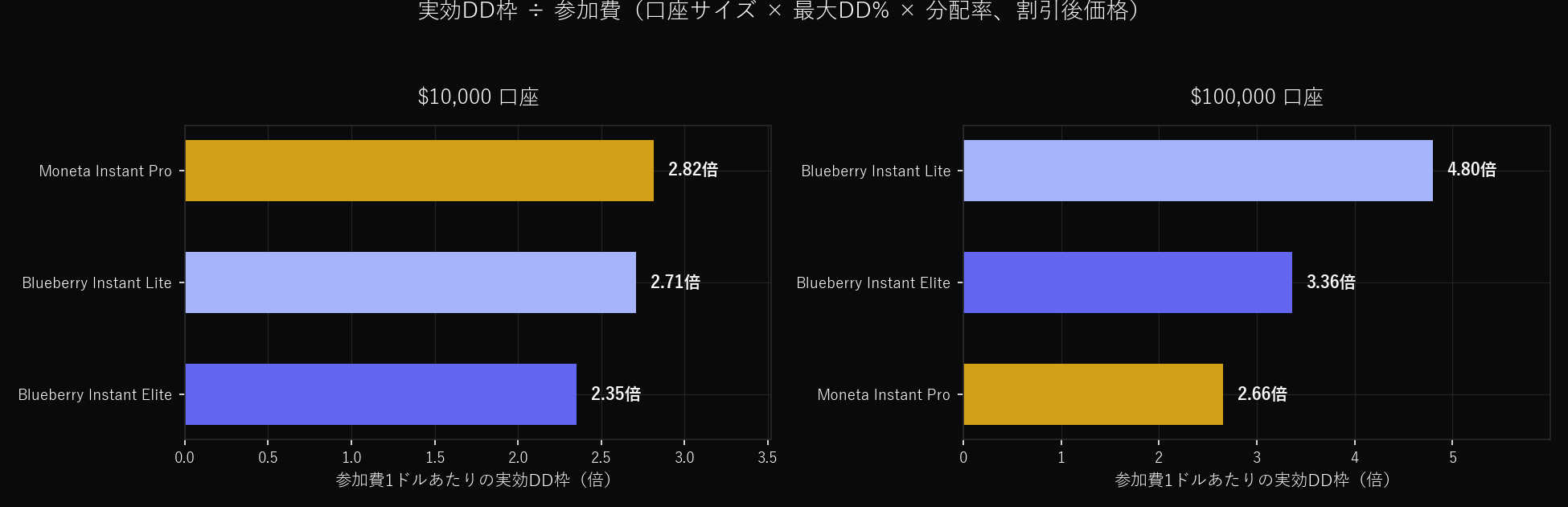
So we recompute using effective DD room = account size × max DD% × profit split.
$10,000 account
| Option | Fee | Total room | Split | Effective room | Effective room ÷ price |
|---|---|---|---|---|---|
| Moneta Instant Pro | $250 | $800 | 88% | $704 | 2.82x |
| Blueberry Instant Lite | $118.15 | $400 | 80% | $320 | 2.71x |
| Blueberry Instant Elite | $340 | $1,000 | 80% | $800 | 2.35x |
$100,000 account
| Option | Fee | Total room | Split | Effective room | Effective room ÷ price |
|---|---|---|---|---|---|
| Blueberry Instant Lite | $667.25 | $4,000 | 80% | $3,200 | 4.80x |
| Blueberry Instant Elite | $2,380 | $10,000 | 80% | $8,000 | 3.36x |
| Moneta Instant Pro | $2,650 | $8,000 | 88% | $7,040 | 2.66x |
The ranking flips depending on size. At $100K, Blueberry Instant Elite beats Moneta Instant Pro by 26%. At $10K, Moneta beats Blueberry by 20%.
The reason is how each firm steps its pricing. Blueberry Elite goes from $400 ($10K) to $2,800 ($100K) — a 10x jump in size for only a 7x jump in price. Moneta Instant Pro goes from $500 to $5,300, a 10.6x jump. In other words, Blueberry is priced cheaper at large sizes, Moneta is priced cheaper at small sizes. The half-off coupon just amplifies Moneta's small-account advantage further.
2. Break-even needs to be read together with the "daily profit cap"
The profit needed to recoup the fee is fee ÷ (account size × profit split).
| Option | Break-even at $10K | Break-even at $100K |
|---|---|---|
| Moneta Instant Pro | 2.84% | 3.01% |
| Blueberry Instant Elite | 4.25% | 2.97% |
| Blueberry Instant Lite | 1.48% | 0.83% |
At $100K, Moneta's 3.01% and Blueberry's 2.97% differ by only 0.04 points — effectively identical. By the break-even yardstick, "Moneta with the half-off coupon" and "Blueberry with 15% off" line up cleanly. At $10K it's 2.84% vs. 4.25%, a 1.4-point edge for Moneta.
The "4% daily profit cap" unique to Instant Pro
This is Instant Pro's biggest, and most specific, sticking point. If a day's profit reaches 4% of the account, all positions are automatically closed on the spot and you can't trade again until the next day.
After the 88% split, the maximum payout you can lock in on a single day is 3.52% of the account — $3,520 for $100K. The $2,650 fee is equivalent to 2.65% of the account, which means:
- Even devoting an entire near-max day purely to the fee leaves only $870 behind.
Flip that around: recovering the fee requires at least one "day maxed out to the cap," or accumulating 3.01% over several days. Blueberry Instant Elite has no such cap.
The heavier a strategy leans on big single hits, the more this cap bites. Designs that let a news event run or ride a breakout have only the upside sliced off. Conversely, strategies that grind up steadily rarely even approach 4%, so it's not much of a real constraint for them. Check whether this applies to your own strategy before you look at the price difference.
A prop account always starts in the red
Whatever the plan, the moment you pay the fee, the account starts behind by exactly that amount. For $100K Instant Pro, that's a $2,650 head start against you. "The account holds $100K" and "you're trading with $100K" are not the same thing — don't forget that basic fact.
3. Per-trade-idea risk cap: this directly shapes your lot sizing
The DD-room discussion is about "how much you can lose in total," but what actually constrains real EA or discretionary design is the per-trade-idea risk cap.
| Option | Per-trade-idea cap | Consequence of breach |
|---|---|---|
| Moneta Instant Pro | Floating loss on the same symbol 3%, then 1.5%/idea | All positions auto-closed + trading paused for the day (treated as a warning). Exceed 1.5% after that and you fail. Lifting it requires 14 days plus 20 trades on a separate account |
| Moneta standard Instant | Floating loss on the same symbol 2%, then 1.5%/idea | Same as above |
| Blueberry Instant Elite / Lite | 1.5% (based on the initial account size) | Immediate account closure, no warning |
Reading these:
- Blueberry's 1.5% means instant closure — there's no grace period. Re-entering the same symbol, or a correlated symbol, in the same direction within 10 minutes of stopping out is aggregated as the same idea.
- Moneta's rule works differently. Instant Pro triggers a full close plus a same-day pause at 3% (2% for standard Instant), and the account survives — but a 1.5%-per-idea cap is then added on top. Lifting it requires 14 days plus 20 trades on a separate funded account. Trip it once and you're effectively frozen for two weeks — a heavier penalty than any other firm we've seen.
- Both firms judge by "one market view," not "one order." Splitting 0.7% into three entries still totals 2.1% and counts as a breach, so split-entry or scale-in strategies need to check the cap before designing lot sizes, or risk an accident.
4. Prohibited rules and EAs: how freely can you build?
| Moneta Instant Pro | Blueberry Instant Elite | |
|---|---|---|
| EA | Self-built only (commercial/third-party EAs prohibited) | Allowed (with conditions) |
| Supported platform | MT5 / MatchTrader | MT5 / TradeLocker |
| Martingale / grid | Prohibited | Allowed (for purchases from March 12, 2026) |
| Copy trading | Only between your own Moneta accounts | Copying from others prohibited; between your own accounts allowed |
| Hedging | Cross-account hedging prohibited | Within the same account only |
| News | Allowed (standard Instant bans trading ±5 minutes) | Not allowed (high-impact indicators) |
| Consistency rule | None | None |
| Minimum trading days | None | 5 days (only days with profit ≥0.5% of balance count) |
| Leverage | FX 1:30 | FX 1:30 |
| Payout cycle | – | 14 days (minimum $100) |
| No trading | Fails after 30 days | Fails after 30 days |
This is genuinely a mixed bag:
- Moneta's strength is that news trading is allowed. Blueberry's Instant Elite help center explicitly states "High Impact News Trading: Not permitted." If your strategy trades around news events, Moneta is the only option.
- Blueberry's strength is that martingale and grid are allowed (for accounts purchased from March 12, 2026 onward). Few prop firms let you bring in scale-in-style logic.
- If you want to run a commercial EA, Moneta isn't an option. Self-built EAs only.
- Neither supports MT4. Moneta runs MT5/MatchTrader, Blueberry runs MT5/TradeLocker. Blueberry's homepage says "Trade on MT4 & MT5," but there's no MT4 option on the actual purchase screen.
- Blueberry's "minimum 5 trading days" is heavier than it looks. It's not simply 5 days of trading — only days with profit of 0.5% of balance or more count. That's a real handicap for short-decision strategies.
- Leverage is 1:30 on both. Any logic built around margin efficiency won't carry over as-is on either firm.
5. Running it through Monte Carlo
Now let's actually run it with matched conditions. We use the same random sequence across every plan so this is a paired comparison — the same person running the same strategy on each.
Conditions: 40,000 runs × 60 trading days. Daily P&L is a normal distribution (standard deviation 1%) as a fraction of the initial balance. Each plan's daily loss cap, max DD (trailing lock), daily profit cap, and consistency rule are all implemented. Payout is simplified to a single lump sum at the end of the period; a failed run pays nothing and the fee is not refunded.
The script is available for download. Download sim-instant-moneta-vs-blueberry.py (Python + NumPy, fixed random seed). Run python sim-instant-moneta-vs-blueberry.py yourself and you'll get the same numbers as this article. Swap in your own strategy's daily edge and volatility, and it'll tell you which plan favors your particular skill level. Edit SIGMA (daily vol) near the top and the for mu in (...) line at the bottom (daily edge). To change the plan conditions, edit the BOOKS lines.
$100,000 account
| Skill (60 days) | Moneta Instant Pro | Blueberry Instant Elite | Blueberry Instant Lite | |
|---|---|---|---|---|
| ±0% | Avg. take-home | −$120 | +$30 | +$29 |
| Probability of profit | 32.3% | 34.2% | 9.4% | |
| Failure rate | 45.9% | 30.1% | 90.5% | |
| +3% | Avg. take-home | +$1,354 | +$1,396 | +$552 |
| Probability of profit | 46.8% | 49.2% | 14.3% | |
| Failure rate | 33.3% | 19.7% | 85.5% | |
| +6% | Avg. take-home | +$3,226 | +$3,106 | +$1,315 |
| Failure rate | 22.4% | 11.6% | 79.6% | |
| +12% | Avg. take-home | +$7,847 | +$7,287 | +$3,677 |
| Failure rate | 8.0% | 3.3% | 65.9% |
Moneta and Blueberry Elite split cleanly. At small edges, Blueberry Instant Elite comes out ahead — it fails less often, so its expected value is higher, and it's even slightly positive on average at zero edge. Above roughly +6% edge, Moneta Instant Pro overtakes it. The gap between the 88% and 80% splits outweighs the failure-rate difference.
Blueberry Elite has the lowest failure rate at every skill level. It has no daily loss cap and a wide 10% DD. Instant Pro's "4% daily + 8% trailing" combination is a structure that gets hit twice.
The consistency rule is a "hold," not a "confiscation"
Instant Lite has a 15% consistency check: at the time of a payout request, the single best day's profit must be within 15% of total profit.
The wording from the official help center matters here. It states: "If the condition isn't met, the request is paused rather than declined, and it releases once further trading balances it out. Nothing is deducted."
In other words, this isn't a rule that erases profit — it's a rule that delays the payout. So in this simulation, we don't subtract anything from the take-home; instead we report the fraction of runs held up by the check as of day 60, as a separate number.
| Instant Lite ($100K) | ±0% | +3% | +6% | +12% |
|---|---|---|---|---|
| Payout-hold rate | 8.6% | 12.3% | 15.8% | 19.7% |
The hold rate climbs as skill rises. More accounts survive with a profit, which increases the pool that can trip the check. Passing it requires total profit to be roughly 6.7x the best single day; at 1% daily vol the best day tends to run around +2.3%. That means you generally need to have run the account up to around 15% before the first payout goes through smoothly.
Instant Lite becomes a different plan if you cut your lot size
The reason Lite's failure rate hits an extreme 90.5% in the table above isn't that the plan is bad — it's that it's carrying a 1% daily-vol lot size on a 4% DD account. This comparison holds the volatility constant across plans on purpose (same person, same lot size), which leaves Lite the only one under-sized for its own room.
So, running all plans, including Lite, at half the lot size (0.5% daily vol, edge scaled down proportionally too) changes the picture.
| All plans, half lot size (equivalent to +6% edge over 60 days at full lot) | Avg. take-home | Probability of profit | Failure rate | Payout-hold rate |
|---|---|---|---|---|
| Moneta Instant Pro | +$393 | 49.6% | 1.1% | – |
| Blueberry Instant Elite | +$387 | 50.0% | 0.1% | – |
| Blueberry Instant Lite | +$2,004 | 66.3% | 22.4% | 62.7% |
Cutting the lot size lets Lite win decisively. Its fee is under a quarter of the others, and even with a 4% DD its failure rate drops to 22.4%. On the flip side, Instant Pro and Instant Elite drop their failure rates to around 1% but end up paying $2,650 and $2,380 for DD room they never use. This is the same point from Section 1 showing up in the numbers: "if you don't use up the tolerance you were sold, the split eats the difference for nothing."
However, the payout-hold rate jumps to 62.7%. Cutting lot size makes total profit harder to grow, which makes it easier to trip the 15% consistency check. Understand Lite as "cheaper room to buy, but a longer wait for the first payout."
For reference, here's the half-lot Lite broken out by skill level:
| Instant Lite, half lot size | Avg. take-home | Probability of profit | Failure rate | Payout-hold rate |
|---|---|---|---|---|
| Full-lot equivalent ±0% | +$483 | 37.5% | 45.9% | 41.9% |
| Full-lot equivalent +6% | +$2,004 | 66.3% | 22.4% | 62.7% |
| Full-lot equivalent +12% | +$4,105 | 87.5% | 8.0% | 63.9% |
$10,000 account
| Skill (60 days) | Moneta Instant Pro | Blueberry Instant Elite | Blueberry Instant Lite | |
|---|---|---|---|---|
| ±0% | Avg. take-home | +$3 | −$99 | −$49 |
| Failure rate | 45.9% | 30.1% | 90.5% | |
| +3% | Avg. take-home | +$150 | +$38 | +$4 |
| Failure rate | 33.3% | 19.7% | 85.5% | |
| +6% | Avg. take-home | +$338 | +$209 | +$80 |
| Failure rate | 22.4% | 11.6% | 79.6% | |
| +12% | Avg. take-home | +$800 | +$627 | +$316 |
| Failure rate | 8.0% | 3.3% | 65.9% |
At $10K, Moneta Instant Pro has the highest average take-home at every skill level. The "Blueberry wins at small edges" relationship we saw at $100K disappears. The fee, brought down to $250 by the half-off coupon, is now doing its work against Blueberry's $340.
Caveats when reading these numbers
- Officially, max DD and daily DD are judged on equity (including floating P&L). This simulation is based on end-of-day closes, so it doesn't capture cases where an intraday spike triggers a breach. All the failure rates here are therefore lower than the real-world figure would be.
- The per-trade-idea risk cap is not implemented. It's not representable at daily granularity, so we left it out. In reality this cap trims the upper tail, so every plan looks more forgiving here than it actually is.
- The consistency rule is not subtracted from take-home. This follows the official statement that it's "a hold, not a confiscation." Instead, we report the payout-hold rate as a separate figure.
- Payout is modeled as a single lump sum at the end. In reality you can withdraw partway through, so the real-world loss on failure would be somewhat smaller than shown here.
- 1% daily vol with a normal distribution models "a fairly aggressive discretionary style." Grind-style strategies have a skewed distribution, so swap in your own numbers using the distributed script.
6. Who should buy, and who shouldn't
Turning the numbers above into a purchase decision.
Who should buy
- Anyone whose strategy rarely hits 4% in a day. This is the biggest gatekeeper. Hit it and you get fully closed out and paused until the next day, so designs that take one big hit, or let news events run, only get their upside trimmed. Conversely, a style that grinds out 0.5%–1% a day almost never touches this cap, so it's not a real constraint. Check this before the price.
- Anyone who can produce +6% or more over 60 trading days. That's the level where Moneta overtakes Blueberry Instant Elite in the Monte Carlo — average take-home of +$3,226 vs. +$3,106 at $100K. Below that edge, the lower-failure Blueberry has the better expected value.
- Anyone who wants to try it out at $10K. The half-off discount does the most work at small sizes. At $250, effective DD room is 2.82x and break-even is 2.84% — better than any Blueberry instant plan. At $100K it shrinks to roughly even. "Try one first" is a natural entry point at $10K.
- Anyone whose strategy trades around news events. Blueberry Instant Elite bans high-impact news trading outright. If you want to keep trading news, Moneta is the only choice.
- Anyone running a self-built EA on MT5 or MatchTrader. No expiry, no consistency rule, no minimum trading days — it's a natural fit for running something passive for a long time.
Who shouldn't buy
- Anyone whose edge is unproven. At zero edge, 45.9% fail, and only 32.3% finish positive. The fee simply disappears. Even at half price, this isn't something to buy just because it's cheap to try.
- Anyone who prioritizes not blowing the account. At every skill level, Blueberry Instant Elite's failure rate is 10+ points lower — no daily loss cap, and a wider 10% DD. If "I don't want to burn $2,650" is your top priority, go with Instant Elite.
- Anyone who wants to run a commercial or third-party EA. Moneta only allows self-built EAs.
- Anyone running martingale or grid-style strategies. Moneta prohibits it. Blueberry allows it for purchases from March 12, 2026 onward.
- Anyone using MT4 only. Moneta runs MT5/MatchTrader, Blueberry runs MT5/TradeLocker. Neither offers MT4.
If you boil it down to one line
Whether you're confident you can earn 3.4% or more on the account.
The fee difference is $2,650 − $2,380 = $270. The split difference is 88% vs. 80%, an 8-point gap. Closing that $270 gap with an 8-point split advantage requires $3,375 in profit — 3.4% of $100K.
- Can clear 3.4% → the 88% split more than makes up for the higher fee, so go with Moneta Instant Pro
- Can't clear it, or not confident → go with the lower-failure Blueberry Instant Elite
But this is only the crossover point when you look at price and split alone. If your strategy is likely to hit the 4% daily cap, Moneta still isn't the right pick even if you can clear 3.4%.
Conclusion: even at half price, it's not that great a deal
First: at $100K it's roughly even with Blueberry Instant Elite. Break-even is 3.01% vs. 2.97%. Effective DD room favors Blueberry by 26%; average take-home favors Moneta only above roughly +6% edge. That's the actual size of the advantage behind a flashy "50% off." The list price, $5,300, is nearly double Blueberry's $2,800 — so half price is exactly what it takes to bring the two level.
Second: that's why you should try the cheaper plan first. At $10K, Moneta wins on the numbers — 2.82x effective DD room, 2.84% break-even, and the highest average take-home at every skill level in the Monte Carlo. For $250, you find out whether your strategy actually works under this rule set. There's little reason to go straight in at $2,650.
Third: two variables that don't show up in the numbers, and you can only find out by actually running it.
- The 4% daily profit cap. Even a perfect day at the cap nets only 3.52% of the account after the split — for $100K, that's $870 once you subtract the fee. Structurally, it doesn't pair well with a one-big-hit style.
- Execution quality (slippage). This article's Monte Carlo does not model execution quality at all. The less slippage, the higher the realized edge for breakout- and news-style strategies. And as shown above, Moneta overtakes Blueberry above roughly +6% edge. So good execution tips the conclusion toward Moneta, while slippage compounds badly with the 4% cap and makes it worse fast. Moneta is one of the few prop firms that allows news trading, so for someone whose strategy lines up with that, this could pay off.
- Fourth: if avoiding a blown account is the priority, go with Blueberry Instant Elite. No daily loss cap, and a wider 10% DD. Its failure rate came out 10+ points lower than Instant Pro's across every skill level.
- Fifth: for anyone without an edge, buying this just makes the fee disappear. In the zero-edge Monte Carlo, 45.9% of Instant Pro runs failed, and only 32.3% finished positive. A prop account amplifies skill — it's not a substitute for it.
In short: "50% off" is not by itself a reason to buy. The honest assessment is that half price merely brings it level with Blueberry. If you buy, start at $10K. Test the 4% daily cap and your own execution quality with your own strategy there before deciding whether to size up.
FAQ
Q. Does Blueberry's PRIME50 also work on the instant plans?
No. Blueberry's site shows a banner across every page saying PRIME50 FOR 50% OFF, but this is a Prime 2-Step-only code. As of checkout testing on September 10, 2026, trying to apply it to Instant Elite gets rejected with coupon "prime50" is not applicable to selected products. PRIME30, FLEX30, and PRIMEPASS were the same. The only code that works on Instant Elite, Instant Lite, or 1-Step is BERRY15 (15% off). If the banner leads you to expect half price, you'll be caught off guard at checkout.
Q. Why look at the "daily profit cap" together with break-even?
Because it caps how fast you can even reach break-even. Instant Pro auto-closes and ends the trading day once daily profit hits 4%. After the 88% split, the effective payout cap is 3.52%. The $100K fee, $2,650, is equivalent to 2.65% of the account, so even devoting an entire theoretical best day to it leaves only $870 in hand. The intuition of "one good day and I've made the fee back" doesn't hold on this plan.
Q. Why multiply DD room by the profit split?
Because drawdown is judged against the full account size, but profit is only paid out at the split rate. A $10K Instant Pro account can lose up to 8% ($800), but the take-home from any profit earned using that room is only 88%. What you're effectively buying isn't $800 of room — it's $704. Without this correction, plans with a lower profit split look unfairly favorable.
Q. Is "trailing DD" worse than static?
Not as much as you'd think — both firms lock at the initial balance. The line trails up with new equity highs but stops permanently once it reaches the initial balance. In other words, once you've grown the account to +10% (Blueberry Elite) or +8% (Moneta Instant Pro), from that point on it behaves exactly like a static DD — "breach the initial balance and you fail." What you do need to watch is that the line also moves on floating profit — briefly marking a new high on an open position is enough to lock it in.
Q. How much does the profit split difference actually matter?
At $100K, the gap between 88% and 80% is 8 points — 8 cents on every dollar of profit. Closing the fee gap ($2,650 − $2,380 = $270) with that split advantage requires $3,375 in profit — 3.4% of the account. So "go with Moneta if you're confident you can earn 3.4% or more, otherwise go with Blueberry" is the crossover point when you look only at price and split.
Q. Instant Elite or Instant Lite — which should I pick?
It comes down to how far you can cut your lot size. At the same lot size, go with Elite. Lite's 4% max DD / 2% daily DD is a tight room, and at 1% daily vol it fails 90.5% of the time at zero edge, and still 65.9% even with +12% edge. But cut the lot size in half, and Lite's failure rate drops to 22.4% with an average take-home of +$2,004 — far ahead of Elite's +$387. That's because the fee, $667.25, is less than a quarter of Elite's. If you're planning to size small, go with Lite; if you're running full size, go with Elite is the real dividing line. That said, Lite carries a 15% consistency check, and the smaller the lot size, the harder it is to grow total profit — 62.7% of runs had their first payout held up as of day 60. If speed of payout matters, go with Elite.
Q. What if I want to use martingale?
It's officially allowed on Blueberry accounts purchased from March 12, 2026 onward. Moneta prohibits it. Note that scale-in-style logic runs straight into the "per-trade-idea" aggregation rule first. Blueberry's 1.5% triggers immediate account closure with no warning, so check the cap before designing your lot sizing.
Q. Are the coupons still active?
As of checkout testing on September 10, 2026, both TOKONATSU50 (Moneta, 50% off, $5,300 → $2,650) and BERRY15 (Blueberry, all plans, 15% off) were active. Prop firm codes expire on a monthly cycle. This article's price tables assume the codes are applied, so if they've expired, the premise behind the conclusion changes too. Always check the final amount on the checkout screen right before buying.
Related articles
Written by
Hosono P | the prop firm strategist
I buy challenges with my own money and record everything through to the payout. Recorded payouts: ¥6.1M in total from Fintokei, Fundora and Funded7, plus $4,776 from The5ers (as of September 2026). Author of the semi-discretionary EA "ELDRA".