E8 Pro Is Worth Buying at $366 — But Watch Two Catches: the "2% Daily Profit Cap" and "Static DD Stays Static Only Until Your First Payout," Tested Across 40,000 Runs
※ This article is a simulation-based analysis. It is not investment advice. Prices and rules were verified live on the official website's pricing simulator and Help Center on September 13, 2026.
E8 Markets' E8 Pro plan strips out almost every annoying clause you'd expect on a prop account: static drawdown, no consistency rule, no minimum trading days, no news restrictions, and payouts you can request daily. The $100K plan lists at $488, or $366 with code E8.
When it's this straightforward, you start to wonder where they're making it back. There are two places they make it back.
TL;DR
- Verdict: buy it. At $100K with code
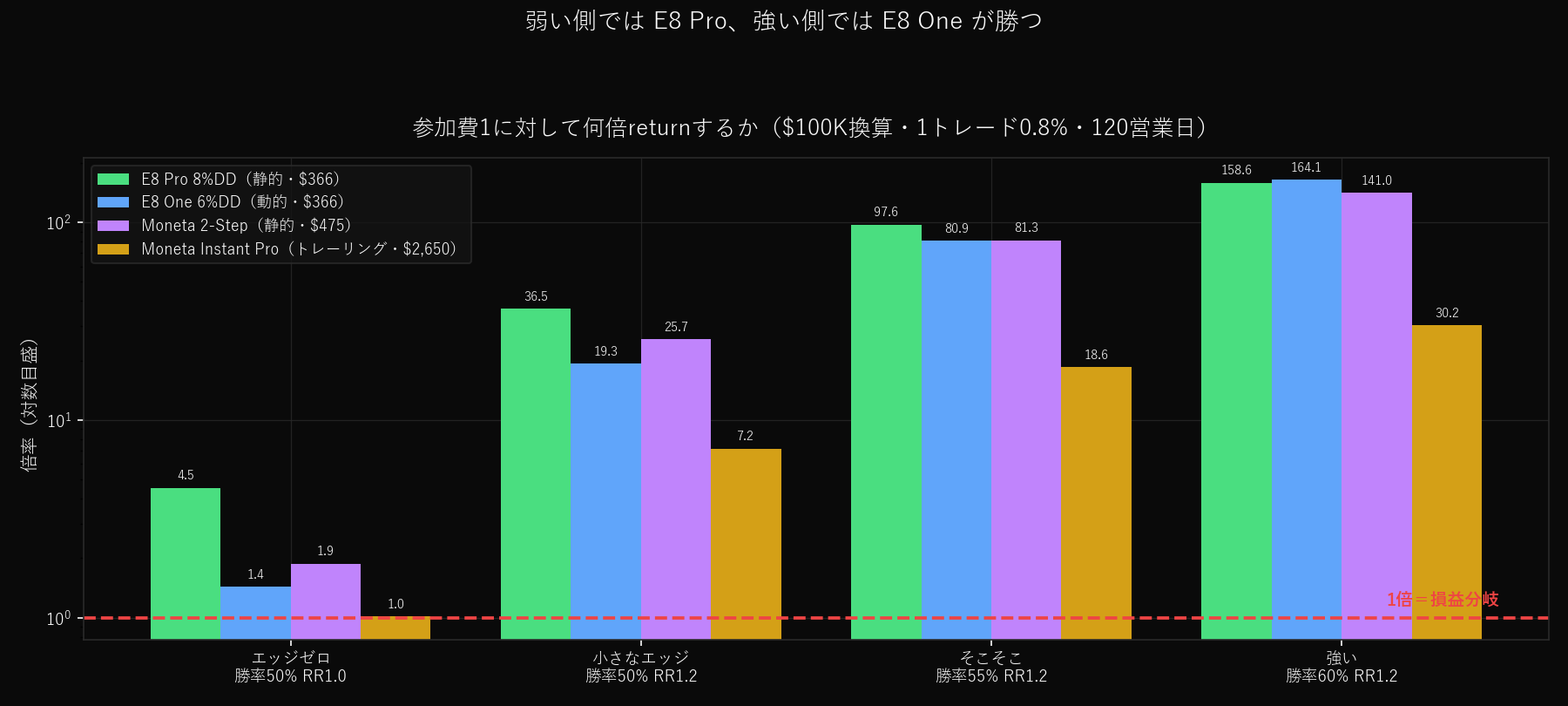
E8applied ($366, i.e. 0.366% of account size), even a "zero-edge" trader (50% win rate, 1:1 RR) has an expected payout of 1.659% — that's 4.53x the entry fee. Compare that to Moneta Instant Pro's 1.01x and E8 One's 1.43x — E8 Pro is a clear head above both - Break-even win rate is about 47.8% (RR 1.0, 0.8% risk per trade). At 48% win rate it's 1.12x; at 50% it's 4.53x. The same-priced E8 One breaks even around 49.6%, so E8 Pro is about 2 points more forgiving
- Catch #1: a 2% daily profit cap. Anything above it gets deleted from the account between 00:00–01:00 the next day (stated officially). Trade through it without knowing, and expected value drops −54% (zero edge) to −16% (strong edge). The weaker your edge, the harder it bites
- Catch #1 has a one-line fix. "If your expected profit target is bigger than what's left of today's cap, stop opening new trades for the day." That alone gets you back to 96% of an uncapped account (zero edge)
- Catch #2: the static DD stays static only until your first payout. The official rules state that once you request your first payout, the static-DD floor permanently moves up to the initial balance. And you can only request 50% of the profit — the other 50% becomes your only lifeline
- Requesting at the minimum (1%) is close to a death sentence for the account. Request at 1% profit and you're left with only a 0.5% buffer. With a 2.5% daily loss limit, that's thin enough to blow in a single day. In the 55%-win-rate simulation, total payouts were $2,575 requesting at 1% vs. $25,754 waiting for 8% — a 10x difference
- The daily 2.5% limit sets your lot-size ceiling. At 3 trades a day, the theoretical ceiling is 0.83% per trade — the size at which 3 losses in a row won't breach 2.5%. Efficiency peaks around 0.8% and then falls off a cliff past that
- Pick "100% profit split," skip the "10% DD" option. The 10%-DD tier ($405) also raises the target to 10%, so it loses in every skill bracket. The 100%-split option ($440) wins in every skill bracket — the $74 extra pays for itself after $370 of cumulative profit. DD choices of 6% ($351, fast but fragile) and 8% ($366, slow but sticky) are roughly a toss-up
- You can buy E8 One for the same $366 (6% DD, 9% target, dynamic DD). The weaker bracket favors E8 Pro, the stronger bracket favors E8 One — they flip at around 60% win rate: 158.6x vs. 164.1x
- If you're running an EA, E8 Pro is the cleaner choice. No consistency rule, no minimum trading days, no news restriction, and off-the-shelf EAs are allowed. But if you fire more than 3 trades a day, the 2.5% daily limit bites first — you'll need to cut lot size
The yardstick
This site always uses the same yardstick: the maximum price worth paying.
Running the same skill, same lot size, same period, the expected amount you actually get back. That's the break-even entry fee — the most you should ever pay for that account. If the real price is below that, buy it; above it, it's overpriced.
As a ratio, that's the multiple (max-worth-paying price ÷ entry fee). 1x is break-even — above that, you're not losing money buying in.
All conditions are shared across the tests: 40,000 Monte Carlo runs, 120 trading days, 3 trades a day, 0.8% risk per trade as a share of account size. Dollar amounts are scaled to account size (for $100K, 1% = $1,000).
E8 Pro specs
Verified live on the official pricing simulator and Help Center on September 13, 2026.
| E8 Pro | E8 One | |
|---|---|---|
| Steps | 1-step | 1-step |
| Profit target | 8% (same rate as the DD chosen) | 9% (1.5x the DD chosen) |
| Max DD | 8%, static (fixed to initial balance, never moves) | 6%, dynamic (tracks locked-in profit, locks at initial balance) |
| Daily DD | 2.5% (based on initial balance) | 4% (~66% of the DD) |
| Daily profit cap | 2% (excess deleted) | none |
| Consistency rule | none | 40% at funded stage |
| Min. trading days | none | none |
| News restrictions | none (both stages) | ±5 min at funded stage |
| Payouts | on demand, daily, min. profit 1% | from day 3, on demand |
| DD / split options | DD 6/8/10%, split 80/100% (purchase-time only) | DD 4/6/8/10/14%, split 80/90/100% |
| $100K list price | $488 | $488 |
After code E8 | $366 | $366 |
The $100K price is identical. So considering E8 Pro basically comes down to asking: is there any reason not to buy E8 One for the same $366?
Full list prices (8% DD, 80% split configuration) for every size are below. Code E8 gives 25% off on all of them.
| Size | $5K | $10K | $25K | $50K | $100K | $200K | $400K | $500K |
|---|---|---|---|---|---|---|---|---|
| List price | $32 | $68 | $148 | $228 | $488 | $998 | $2,098 | $2,598 |
After E8 | $24 | $51 | $111 | $171 | $366 | $749 | $1,574 | $1,949 |
First, the bottom line: four skill brackets
| Skill | Program | Entry fee | Funded rate | Fail rate | Days to funded | Max worth paying | Multiple |
|---|---|---|---|---|---|---|---|
| Zero edge 50% win rate, RR 1.0 | E8 Pro 8%DD | 0.366% | 49.0% | 73.4% | 35 days | 1.659% | 4.53x |
| E8 One 6%DD | 0.366% | 25.9% | 95.9% | 24 days | 0.524% | 1.43x | |
| Moneta 2-Step | 0.475% | 26.2% | 68.6% | 62 days | 0.894% | 1.88x | |
| Moneta Instant Pro | 2.650% | 100% | 82.9% | day 1 | 2.685% | 1.01x | |
| Small edge 50% win rate, RR 1.2 | E8 Pro 8%DD | 0.366% | 85.0% | 28.0% | 27 days | 13.371% | 36.53x |
| E8 One 6%DD | 0.366% | 56.3% | 72.0% | 19 days | 7.054% | 19.27x | |
| Moneta 2-Step | 0.475% | 79.5% | 24.4% | 48 days | 12.206% | 25.70x | |
| Moneta Instant Pro | 2.650% | 100% | 38.9% | day 1 | 18.971% | 7.16x | |
| Decent 55% win rate, RR 1.2 | E8 Pro 8%DD | 0.366% | 97.7% | 4.9% | 18 days | 35.739% | 97.65x |
| E8 One 6%DD | 0.366% | 82.5% | 33.0% | 15 days | 29.614% | 80.91x | |
| Moneta 2-Step | 0.475% | 98.0% | 3.0% | 31 days | 38.607% | 81.28x | |
| Moneta Instant Pro | 2.650% | 100% | 9.6% | day 1 | 49.231% | 18.58x | |
| Strong 60% win rate, RR 1.2 | E8 Pro 8%DD | 0.366% | 99.7% | 0.7% | 13 days | 58.039% | 158.58x |
| E8 One 6%DD | 0.366% | 94.7% | 10.6% | 12 days | 60.056% | 164.09x | |
| Moneta 2-Step | 0.475% | 99.8% | 0.2% | 21 days | 66.990% | 141.03x | |
| Moneta Instant Pro | 2.650% | 100% | 1.8% | day 1 | 79.899% | 30.15x |
Three things stand out here.
First, E8 Pro clears 1x by a wide margin in every skill bracket. Even at zero edge it's 4.53x. That's the combination of a low entry fee (0.366%) and static DD being hard to die on. E8 One at the same price is only 1.43x — the dynamic DD ruthlessly weeds out anyone who doesn't grow fast enough (95.9% fail rate).
Second, the ranking flips with skill. In the weaker brackets E8 Pro beats E8 One by more than 3x, but at 60% win rate they flip: 158.6x vs. 164.1x. The static DD's protection matters most for traders who don't grow fast; the profit cap matters more for traders who do.
Third, the gap with Moneta Instant Pro is an order of magnitude. Instant Pro has the huge advantage of being a funded account the moment you buy it (100% funded rate, day 1) — but the entry fee is 2.650% of the account, so at zero edge it's only 1.01x, essentially break-even. If you want "instant access to a funded account," E8 Pro is dramatically more efficient for the same idea.
Catch #1: the 2% daily profit cap
Both the Challenge and Performance stages of E8 Pro carry a rule: you can only grow the account by 2% of the initial balance per day. For $100K, that's $2,000.
The question is what happens once you exceed it. Here's what the official Help Center says:
If you exceed this 2% Daily profit cap, everything above will increase your balance, but not your total profits/performance results (Exceeds profits above 2% are being removed every day after rollover)
And they even give a worked example:
Opening balance $102,000 / cap $2,000 / cap line $104,000 / closing balance $105,500 → $1,500 is removed at rollover, and the next day's opening balance is $104,000
In other words, only profits get shaved off every day — losses are not. We ran this asymmetry through three parallel scenarios using the same random sequence.
| Skill | ① No cap (reference) | ② Capped, aware of remaining room | ③ Capped, trade through it | ③ / ② | Amount deleted in ③ |
|---|---|---|---|---|---|
| Zero edge | 1.721% | 1.659% | 0.768% | −53.7% | 2.77% |
| Small edge | 14.715% | 13.371% | 7.211% | −46.1% | 9.39% |
| Decent | 40.267% | 35.739% | 26.877% | −24.8% | 16.14% |
| Strong | 66.672% | 58.039% | 48.853% | −15.8% | 22.09% |
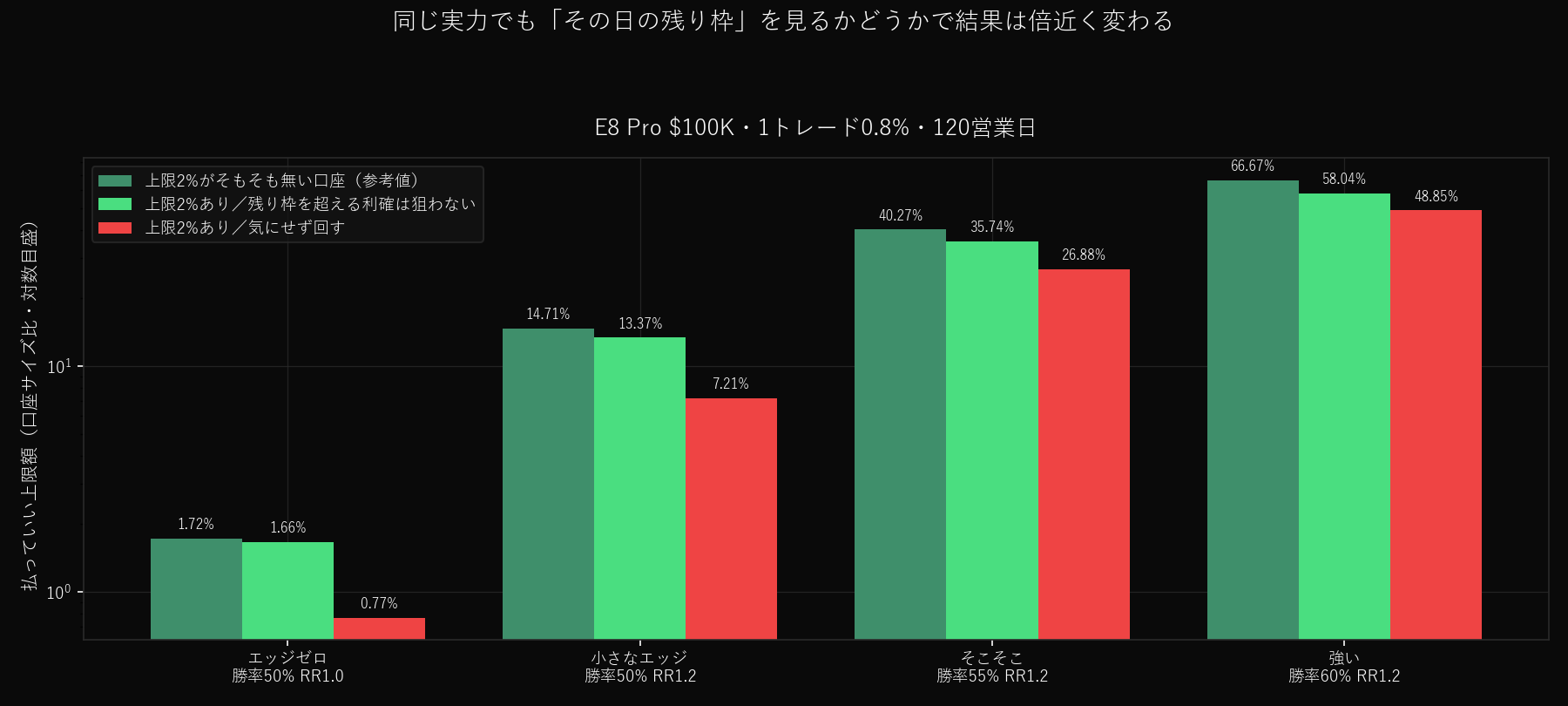
Trade through it without adjusting, and a zero-edge trader's expected value drops to less than half. For $100K, the average amount deleted is $2,770 — 7.6x the $366 entry fee, quietly disappearing without you noticing. Even a strong-edge trader loses $22,090.
The fix is one line
Scenario ② — "stay aware of remaining room" — is just this rule:
Once today's profit reaches "2% minus your expected take-profit distance," stop opening new trades for the day.
At 0.8% risk per trade and RR 1.2, one win is 0.96%. Two wins gets you to 1.92%, leaving only 0.08% of room. Open a third trade here and a win gets 0.88% deleted, a loss costs the full 0.8%. That's a clearly negative-EV trade.
Adding this one rule alone takes zero-edge from 0.768% → 1.659% — 96% of the way back to the uncapped account's 1.721%. Fail rate also drops from 82.1% to 73.4%. The profit cap effectively forces "that's enough for today," which prevents the accident of giving back a good day's gains.
If you're running an EA, put this one line in the code. Just stop opening new positions once the day's realized P&L gets close to the cap. E8's dashboard even shows a metric for "how much of today's cap you've used."
Catch #2: the static DD stays static only until your first payout
E8 Pro's selling point is static DD — it never moves from the initial balance. That's true during the Challenge stage and the funded stage before your first payout.
But the official Help Center says:
When you request the first payout, the static drawdown is moved to the initial balance level
After your first payout, the Static Drawdown loss level is permanently set to your initial balance level
In other words, the moment you request your first payout, the fail line jumps from $92,000 to $100,000. The 8% buffer you had goes to zero.
On top of that, you can only request half of the profit:
When you request a payout, 50% is your payout, and 50% is kept in the account as a buffer
With $100K and $4,000 in profit, requesting a payout gives you $2,000 in payout eligibility (times the 80% split, for a $1,600 take-home), while the remaining $2,000 stays in the account. From this point on, that $2,000 is your only buffer.
E8 frames it as: "the 50% buffer means requesting a payout can never trigger a DD breach." That's correct at the exact moment of the request. It says nothing about whether you survive afterward.
The amount you save up before requesting changes your total payout by 10x
Isolating the funded stage, we ran different policies for "request half once profit reaches X%." Conditions: $100K, 80% split, 0.8% risk per trade, 120 trading days.
| Skill | Payout policy | Fail rate | Received | Left in account | Total |
|---|---|---|---|---|---|
| Zero edge | Request at 1% (fastest) | 100.0% | $1,291 | $0 | $1,291 |
| Request at 2% | 100.0% | $1,780 | $0 | $1,780 | |
| Request at 4% | 99.9% | $2,346 | $1 | $2,347 | |
| Request at 8% | 95.4% | $3,176 | $107 | $3,283 | |
| Never request (theoretical ceiling) | 58.3% | $0 | $3,835 | $3,835 | |
| Small edge | Request at 1% (fastest) | 100.0% | $1,846 | $0 | $1,846 |
| Request at 2% | 100.0% | $2,859 | $0 | $2,859 | |
| Request at 4% | 100.0% | $4,836 | $1 | $4,837 | |
| Request at 8% | 92.9% | $10,593 | $251 | $10,844 | |
| Never request (theoretical ceiling) | 16.5% | $0 | $19,634 | $19,634 | |
| Decent | Request at 1% (fastest) | 100.0% | $2,575 | $0 | $2,575 |
| Request at 2% | 100.0% | $4,044 | $0 | $4,044 | |
| Request at 4% | 100.0% | $8,197 | $0 | $8,197 | |
| Request at 8% | 78.3% | $24,900 | $854 | $25,754 | |
| Never request (theoretical ceiling) | 2.4% | $0 | $42,781 | $42,781 | |
| Strong | Request at 1% (fastest) | 100.0% | $3,656 | $0 | $3,656 |
| Request at 2% | 100.0% | $5,687 | $0 | $5,687 | |
| Request at 4% | 99.8% | $13,760 | $4 | $13,764 | |
| Request at 8% | 50.5% | $46,767 | $2,057 | $48,824 | |
| Never request (theoretical ceiling) | 0.3% | $0 | $64,722 | $64,722 |
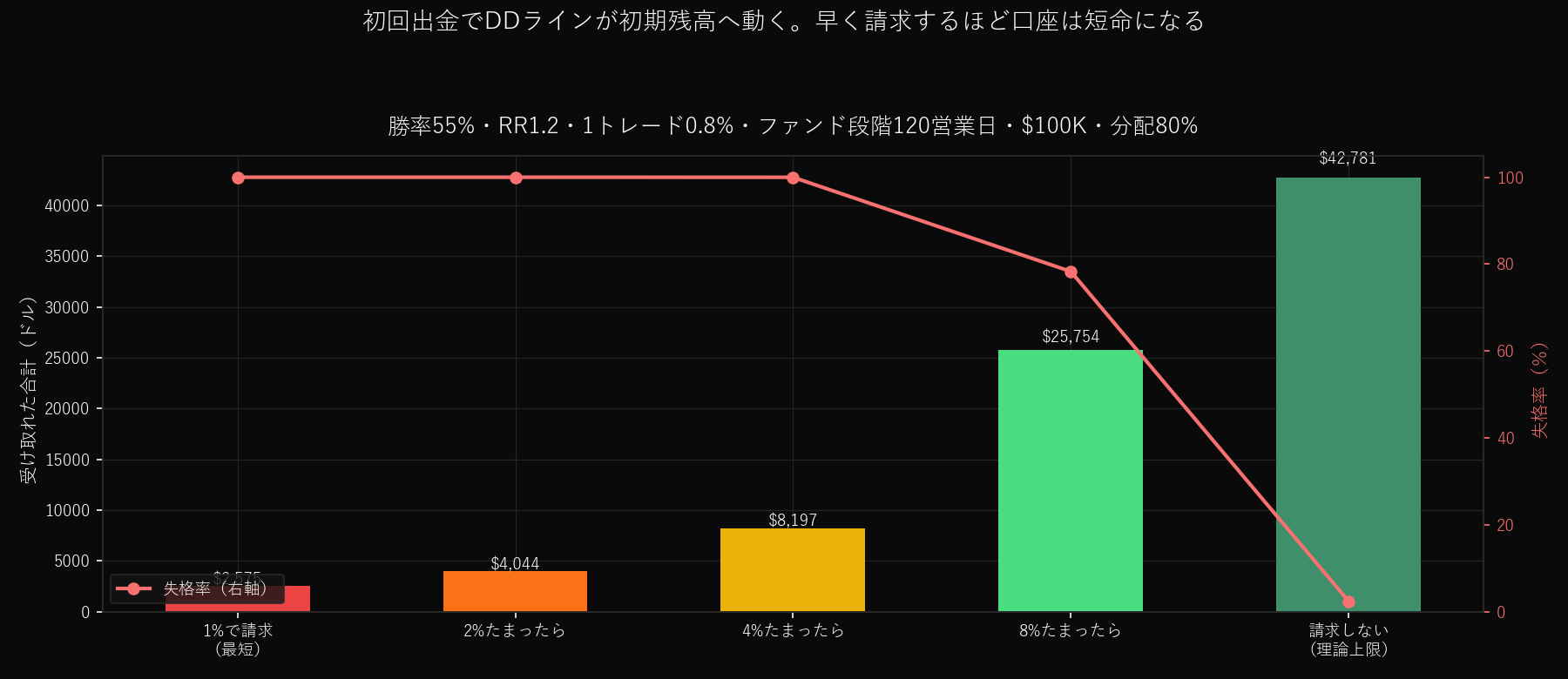
Requesting at the 1% minimum caps total payout at just $2,575 even for a 55%-win-rate trader. Wait for 8% and request then, and it's $25,754 — a 10x difference. For a strong-edge trader, it's $3,656 vs. $46,767 — 13x.
The reason is simple. Request at 1% profit and your remaining buffer is 0.5%. With a daily loss limit of 2.5%, that's thin enough to break in a single trade, let alone a single day. And since E8 Pro only lets you grow 2% a day, rebuilding a thinned-out buffer takes at least several days. It gets shaved off in an instant; rebuilding it takes at least 2.5 days. That's the asymmetry.
Practical rules
- Wait for your first payout until you've hit an amount you'd be okay ending on. Wait for 8% ($8,000 on $100K) before requesting, and your remaining buffer is 4% ($4,000) — 1.6 days' worth of the 2.5% daily limit
- Always cut lot size after requesting a payout. If your buffer drops to 4%, and you were running at 0.8%, cut to 0.4%. An account that's lost its static DD is functionally a trailing-DD account
- "You can withdraw every day" does not mean you should
Note that the 50% you leave in the account isn't forfeited — it's included in the next request cycle (stated officially). It's deferred, not lost. But you're exposed to fail risk the whole time in between — that's the point being made here.
How high can lot size go
E8 Pro's daily loss limit is 2.5%. And it's based on the initial balance, so it stays at $2,500 even as the account grows.
This effectively sets the ceiling on lot size. With n trades per day, the practical ceiling is the size where n consecutive losses won't exceed 2.5%.
| Trades/day | Theoretical lot ceiling |
|---|---|
| 2 | 1.25% |
| 3 | 0.83% |
| 5 | 0.50% |
| 8 | 0.31% |
Here's what actually happens (50% win rate, RR 1.2, fixed 3 trades/day):
| Risk per trade | 3 losses in a row | E8 Pro fail rate | E8 Pro multiple | E8 One fail rate | E8 One multiple |
|---|---|---|---|---|---|
| 0.25% | 0.75% | 0.4% | 5.51x | 6.4% | 4.35x |
| 0.40% | 1.20% | 4.4% | 15.77x | 33.5% | 12.73x |
| 0.50% | 1.50% | 9.8% | 23.00x | 49.3% | 16.38x |
| 0.65% | 1.95% | 19.4% | 29.05x | 63.5% | 18.69x |
| 0.80% | 2.40% | 28.0% | 36.53x | 72.0% | 19.27x |
| 0.83% | 2.49% | 29.6% | 37.58x | 73.1% | 19.45x |
| 0.90% | 2.70% | 100.0% | 0.00x | 75.5% | 19.59x |
Efficiency improves as you raise lot size up to 0.83%, then falls off a cliff at 0.90%. With 3 trades a day, 3 losses in a row breaches 2.5% — and over 120 trading days, you're bound to hit that streak somewhere.
E8 One has no cliff. Its daily limit is a wider 4%, so raising lot size only pushes the fail rate up gradually. If you want to raise lot size and settle things fast, go E8 One; if you want to keep lot size down and survive long-term, go E8 Pro.
High-frequency EAs need to be careful. At 8 trades a day you'd need to cut to 0.31%, or the 2.5% daily limit bites first. E8 Pro is built to reward low-frequency approaches.
Choosing a configuration
E8 Pro lets you choose DD (6% / 8% / 10%) and profit split (80% / 100%) at purchase. The target matches the DD rate — choose 10% and the target rises to 10% too. The daily 2.5% limit stays the same across every configuration.
| Configuration | $100K list | After E8 | Zero edge | Small edge | Decent | Strong |
|---|---|---|---|---|---|---|
| E8 Pro 6%DD, 80% split | $468 | $351 | 4.55x | 35.62x | 99.68x | 166.60x |
| E8 Pro 8%DD, 80% split | $488 | $366 | 4.53x | 36.53x | 97.65x | 158.58x |
| E8 Pro 10%DD, 80% split | $539 | $405 | 3.62x | 32.19x | 86.02x | 139.75x |
| E8 Pro 8%DD, 100% split | $586 | $440 | 4.71x | 37.99x | 101.53x | 164.88x |
| E8 One 6%DD, 80% split | $488 | $366 | 1.43x | 19.27x | 80.91x | 164.09x |
| E8 One 8%DD, 80% split | $586 | $440 | 1.41x | 20.19x | 76.01x | 140.99x |
Only the 10%-DD option loses in every skill bracket. The target rises by the same amount as the DD, so the wider buffer's benefit is eaten by the heavier target. And since you can only grow 2% a day, hitting a 10% target takes at least 5 trading days. Priced 11% higher with nothing to show for it.
6%DD and 8%DD are roughly a toss-up, but for different reasons underneath.
| 6%DD ($351) | 8%DD ($366) | |
|---|---|---|
| Target | 6% (min. 3 trading days) | 8% (min. 4 trading days) |
| Fail rate (zero edge) | 80.9% | 73.4% |
| Days to funded | 24 days | 35 days |
| Multiple (strong edge) | 166.60x | 158.58x |
6%DD is "fast but fragile," 8%DD is "slow but sticky." Since the multiples are close, the choice comes down to: 6% if you trust your edge, 8% if you're still finding out.
The 100% profit split always wins. The gap is $440 − $366 = $74. Going from 80% to 100% split means you keep 1.25x as much of every payout, so $370 of cumulative profit pays it back. With a minimum payout line of 1% profit ($1,000), reaching even a single payout is close to a guaranteed recovery.
Note that both split and DD are locked in at purchase and can't be changed later. Always pick 100% split.
What win rate do you need to break even
We searched for the win rate that matches the $366 (0.366%) entry fee, at RR 1.0 and 0.8% risk per trade.
| Win rate | E8 Pro max worth paying | E8 Pro multiple | E8 One max worth paying | E8 One multiple |
|---|---|---|---|---|
| 46% | 0.071% | 0.19x | 0.011% | 0.03x |
| 47% | 0.177% | 0.48x | 0.034% | 0.09x |
| 48% | 0.409% | 1.12x | 0.093% | 0.25x |
| 49% | 0.871% | 2.38x | 0.231% | 0.63x |
| 50% | 1.659% | 4.53x | 0.524% | 1.43x |
| 52% | 4.698% | 12.84x | 1.965% | 5.37x |
| 55% | 13.466% | 36.79x | 8.144% | 22.25x |
E8 Pro breaks even at about 47.8%, E8 One at about 49.6%. For the same $366, E8 Pro is roughly 2 points more forgiving.
In other words, even a trader with a win rate below 50% at RR 1.0 can recover the entry fee with E8 Pro. That comes from both "the entry fee is only 0.366% of the account" and "static DD doesn't kill you instantly for slow growth."
But this is the number after fixing Catch #1. Trade through the profit cap without adjusting, and the same 50% win rate multiple falls from 4.53x to 2.10x.
Who should buy it
Buy it if you're...
- Running an EA. No consistency rule, no minimum trading days, no news restriction, off-the-shelf EAs allowed. This is the configuration with the least room for prop-side discretion
- A trader around 50% win rate living off RR. This is exactly where static DD's protection matters most
- Trading few times a day (3 or fewer). Comfortably fits inside the 2.5% daily limit
- Wanting to try one account as a test. $5K is $24, $10K is $51. About the cheapest tuition money in this category
Skip it if you're...
- A scalper or high-frequency EA firing many times a day. The 2.5% daily limit bites first, forcing you down to around 0.3% lot size. E8 One (4% daily) is the more natural fit
- Someone who takes big single-day wins. Anything above 2% gets deleted every day. Structurally at odds with a "grab it all on a trend day" style
- Confident at a 60%+ win rate level. At the same $366, E8 One comes out ahead (164.1x vs. 158.6x). With no profit cap, skill translates directly into dollars
- Wanting to withdraw a large lump sum quickly. You can only request 50% of profit, and requesting it is exactly what kills the static DD
Assumptions and limits
- Spreads, swaps, and slippage are not modeled. In reality every program's numbers would be lower by this amount. E8 states officially that "even the simulated environment carries slippage"
- Wins and losses are assumed independent. Real markets cluster losing streaks, so real fail rates would run higher than calculated here
- No retry after failing. In reality you can buy again, so the real-world expected value for the cheaper E8 Pro would be somewhat better
- No overnight positions. Holding overnight means floating losses count directly against DD and the daily limit, which would hurt both programs' numbers
- Fixed at 3 trades/day. More trades makes the 2.5% daily constraint bite much harder, so E8 Pro's numbers are sensitive to trade frequency (at 5 trades/day the lot ceiling is 0.50%)
- E8 One's 40% consistency rule is not modeled. Adding it would push E8 One's numbers down further, which would strengthen the conclusion in E8 Pro's favor
- Payout fees and settlement time are not reflected
- The rules include a discretionary clause. "If we detect prohibited activity, we may limit risk per trade idea to 1%" is written into the terms. Trigger it and your lot size is effectively cut by more than half, which breaks the math above
- Trustpilot ratings are currently suspended (as of September 13, 2026 — shows "guideline violation," "fake reviews removed." 3,298 reviews, score hidden). No matter how good the numbers look, verify the operator's reliability separately yourself
- No refund on the entry fee. The official terms state "we do not currently offer a mechanism to refund the entry fee on the first payout"
Scripts are available for download. Download sim-e8-pro.py (Python + NumPy, fixed random seed). Edit lines like E8_PRO_8 to recalculate with your own win rate, RR, lot size, and period.
FAQ
Q. Does the profit above the 2% daily cap really get deleted?
Yes, it does. The official Help Center states that "profit above the cap is automatically removed from the account balance every day between 00:00 and 01:00 server time," and gives a worked example of $1,500 being deleted on a day that started at $102,000 and ended at $105,500. You don't need to calculate it yourself — the system removes it automatically.
Also note: splitting a large winning position into partial closes, or holding it across days to dodge the cap, is prohibited. The official position is that they may "treat it as a single trade idea and aggregate its profit into a single day."
Q. Does the static DD move up to the initial balance when you "request" a payout, or when it "settles"?
Officially it's "when you request" the first payout. Design around the line moving before settlement, not after.
Q. Which DD should I pick — 6%, 8%, or 10%?
Don't pick 10%. The target also rises to 10%, so the benefit of a wider buffer gets eaten by the heavier target. It loses in every skill bracket (4.53x vs. 3.62x at zero edge; 158.58x vs. 139.75x at strong edge). Priced 11% higher with nothing to show for it.
6% ($351) and 8% ($366) are roughly a toss-up. 6% has a 6% target too, so it clears in as little as 3 trading days and reaches funded in an average of 24 days (vs. 35 for 8%). In exchange, its zero-edge fail rate is 80.9%, 7 points higher than 8%'s 73.4%. Buy 6% for speed, 8% for staying power.
Q. Is the $74 gap between 80% and 100% split worth paying?
Yes. Since the split becomes 1.25x, $370 of cumulative profit pays it back. With a minimum payout threshold of 1% profit ($1,000 on $100K), reaching even one payout is close to a sure recovery. And it can only be chosen at purchase — it can't be changed afterward.
Q. What's the fastest I can hit the 8% target?
4 trading days. Since you can only add 2% a day, you'd need to hit the cap 4 days running. E8 One has no cap, so it can clear in as little as 1 day. If you want "buy today, funded today," this isn't E8 Pro.
Q. Can I run an EA?
Yes — off-the-shelf EAs are allowed too (though the same EA can't be used by multiple users). E8 Pro has no consistency rule, no minimum trading days, and no news restriction, making it the best-fitting of E8's three plans for EA use. That said, trades closed in under a minute making up more than 50% of all trades gets flagged as HFT and is banned, as is arbitrage or latency trading.
Q. Is the 2.5% daily limit based on the day's opening balance, or the initial balance?
Initial balance. The Help Center states "you must not lose more than 2.5% of the initial balance in a single day." Even if a $100K account grows to $120,000, the daily loss limit stays at $2,500. The more the account grows, the tighter it feels, relatively speaking.
Q. How does it compare to Moneta Instant Pro?
E8 Pro wins decisively on capital efficiency. Instant Pro has the strong advantage of being funded the instant you buy it, but the entry fee is 2.650% of the account ($2,650 on $100K), so at zero edge the multiple is 1.01x — essentially break-even. E8 Pro under the same conditions is 4.53x. A $366 one-step account beats a "discounted instant account" even after the coupon. See Testing the expected value of instant accounts for details.
Q. How long is code E8 valid?
As of September 13, 2026, no expiration is shown. It applies 25% off across all three Forex plans (E8PATH gives the same rate). The older codes BESTPROMO and SOPF were confirmed invalid at checkout. Codes with a listed deadline tend to expire — always confirm the real price at checkout before buying.
Related articles
Written by
Hosono P | the prop firm strategist
I buy challenges with my own money and record everything through to the payout. Recorded payouts: ¥6.1M in total from Fintokei, Fundora and Funded7, plus $4,776 from The5ers (as of September 2026). Author of the semi-discretionary EA "ELDRA".