E8 Pro vs E8 One: Which Should You Buy? Comparing "Static 8% + 2%/day cap" vs "Dynamic 6% + 40% Consistency" at the Same $366, for Both Smoothed and Spiky P&L [September 2026]
※ The rules and prices in this article were measured directly on E8 Markets' official site, pricing simulator, and help center on September 13, 2026 (full figures in the E8 Markets guide). The simulation combines Monte Carlo and real-data testing; it does not guarantee future performance and is not investment advice.
TL;DR: it comes down to the "shape" of your P&L. Smooth it out → Pro. Let it spike → One.
All three of E8 Markets' Forex plans are one-step, so the real choice is between E8 Pro and E8 One. At $100K, both list for $488, and both drop to $366 with code E8. Price alone doesn't decide this.
| E8 Pro (8% DD) | E8 One (6% DD) | |
|---|---|---|
| Max DD | 8% static (from starting balance). But the first payout request permanently moves the fail line to the starting balance | 6% dynamic (tracks the highest confirmed balance). Once it reaches the starting balance, it locks permanently, equivalent to static from then on |
| Daily loss | 2.5% (from that day's opening balance) | 4% (same basis) |
| Target | 8% | 9% |
| Profit restriction | Daily profit cap of 2%. Excess is deleted from the account the next day (both evaluation and funded) | 40% consistency rule in Performance stage (payout is held if the best day exceeds 40% of period profit) |
| Payout | Daily. But you can only claim 50% of profit, minimum profit 1% | On-demand (from roughly 3 days after Performance starts), minimum payout $100 |
| Min. trading days | None (but the 2% cap effectively requires at least 4 days to reach the 8% target) | 1 day |
| News | No restriction | Front/back 5 minutes in Performance stage only |
| Split | 80% (+$98 for 100%) | 80% (90/100% available as add-ons) |
Here's what the numbers showed:
- Traders who fire 3+ times a day and smooth out P&L (scalping, high-frequency EAs) should buy Pro. In Monte Carlo (3 trades/day, 120 trading days): 4.5x vs 1.4x at zero edge, 36.5x vs 19.3x at small edge, 97.6x vs 80.9x at decent edge. Only strong traders see the order flip (158.6x vs 164.1x)
- Traders who trade once a day and earn most of their profit from a handful of big days a year (session-based trend-following, breakouts) should buy One. Across two real-data "waves" we run on this site, One earns +¥3.09M/+¥5.85M per year, while Pro tops out at +¥630K/+¥1.37M even with the best payout policy. A 2–4x gap
- What drives the difference is Pro's "2% daily profit cap." Spiky P&L concentrates most of its profit in a handful of big days per year, and cutting that day off at 2% erases 8–27% of that winning day's profit. Smoothed P&L never reaches 2% in a day, so it loses nothing
- The other factor is Pro's payout structure. The moment you request a payout, the fail line jumps to the starting balance, leaving only the 50% you kept in the account as a buffer. If you take "you can withdraw daily" literally and claim at 1%, real-data testing shows you end up with a fifth of what One delivers
For configuration: with Pro, pick 8% DD (6% DD has the same buffer width for a lower target, no benefit; 10% DD raises the target to 10% too). With One, pick 6% DD at $488 (8% DD at $586 doesn't scale its multiplier as price rises). The 100% split add-on (Pro: +$98) pays for itself once total profit reaches $490.
Three structural differences
1. Static 8% vs dynamic 6% (with a lock)
Pro's 8% never moves from the starting balance. One's 6% chases "highest confirmed balance − 6%," but once the highest balance reaches the starting balance (i.e., +6%), the floor locks at the starting balance and never rises further. So One is really a two-stage system: "trailing until you're up 6%, then static."
The difference in the evaluation stage is small. Pro goes for an 8% target with an 8% buffer, while One goes for a 9% target with a 6% buffer, so target ÷ buffer is 1.0 for Pro vs 1.5 for One, making One's evaluation heavier. On the other hand, daily loss is 2.5% for Pro vs 4% for One, so One lets you fire 1.6x as much in a day.
Things flip once funded. For Pro, the moment you request your first payout, the fail line jumps to the starting balance, and the only buffer from then on is the 50% of profit you left in the account. For One, once you've cleared +6%, the floor is already locked at the starting balance, and withdrawing doesn't move that floor. One's "post-payout container" is more stable — this is the first reason it wins in the real-data test.
2. A 2% daily profit cap vs a 40% consistency rule
Pro's "2% daily profit cap" doesn't just exclude the excess from the target — the excess is actually deleted from the account between midnight and 1 AM server time the next day (the official help article gives the example: opening $102,000, closing $105,500 → $1,500 disappears and the next day opens at $104,000). This applies in both evaluation and funded stages, and splitting trades or straddling days to dodge it is explicitly banned.
One's 40% consistency rule is a condition in Performance stage: "the best day within the payout period must not exceed 40% of that period's profit." If you breach it, the profit isn't erased — the payout is simply held until it's diluted by further profit.
These two features have opposite effects depending on the shape of your P&L.
| Shape of P&L | Pro's 2% cap | One's 40% consistency |
|---|---|---|
| Firing many times a day, smoothed out (daily swing roughly ±1%) | Almost never triggered. No real harm | Best day rarely exceeds 40%. No real harm |
| Once a day, concentrated in big days (a handful of +5–18% days per year) | That day's profit gets cut at 2%, erasing 8–27% of the winning day's profit | Payout gets held right after a big day, but the profit stays intact |
3. Daily, 50%, moving line vs on-demand, full amount
Pro lets you request a payout daily, but you can only claim 50% of profit, and the first request moves the fail line to the starting balance. As shown in our E8 Pro article, requesting daily at 1% nets even a 55%-win-rate trader only $2,575 in total, versus $25,754 if you accumulate to 8% first and then request — a 10x difference. One doesn't move its floor on a request, so this decision doesn't even come up.
Monte Carlo: smoothed P&L favors Pro
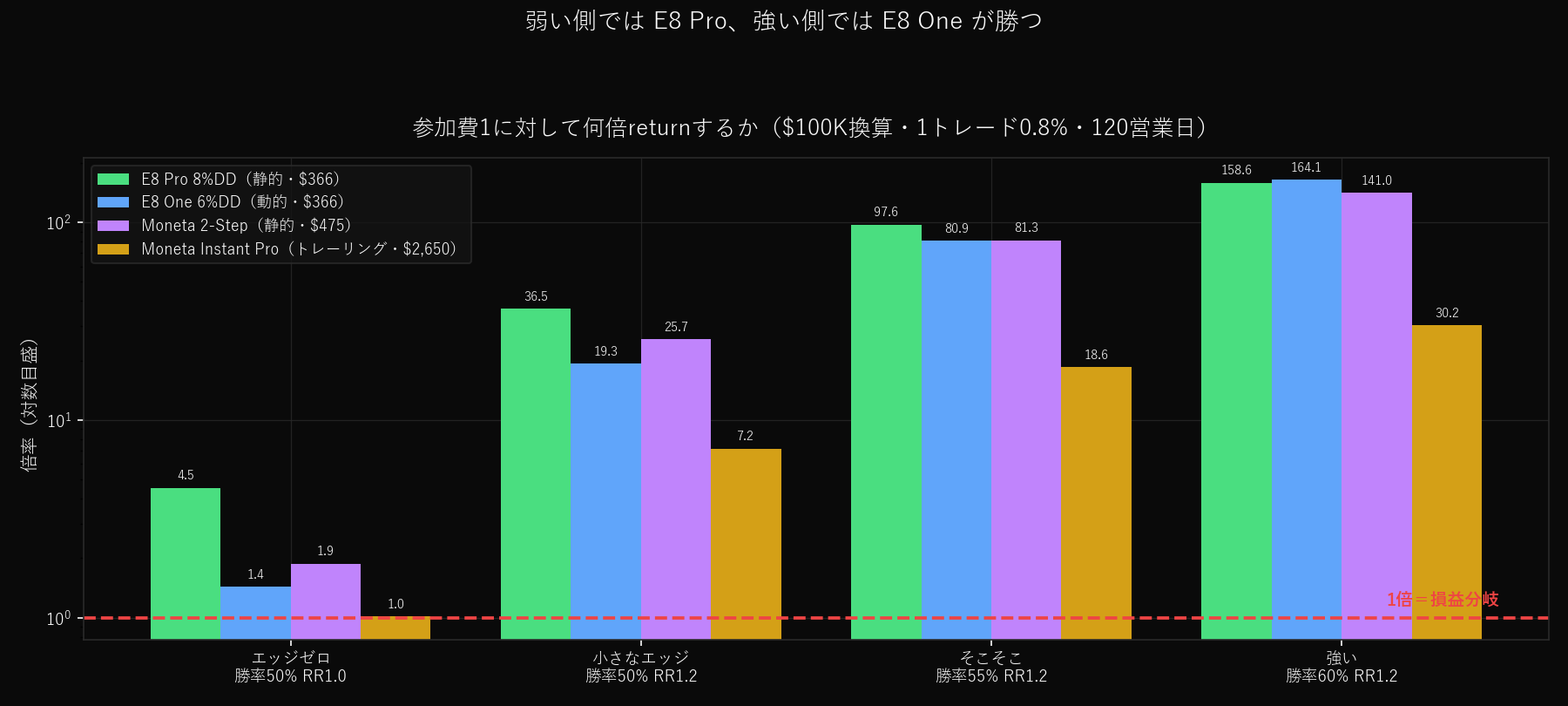
One trade = win rate p, +R×r on a win, −r on a loss. 3 trades/day, 120 trading days, 40,000 runs. Pro is modeled with disciplined trading that "never targets a take-profit that would exceed the day's remaining cap." Multiple = expected payout ÷ entry fee (1.0x is break-even).
| Edge | Per-trade risk | Pro 8% ($366) | Reach | Fail | One 6% ($366) | Reach | Fail | One 8% ($440) |
|---|---|---|---|---|---|---|---|---|
| Zero edge, 50%, RR1.0 | 0.5% | 2.0x | 36% | 47% | 1.2x | 24% | 87% | 0.7x |
| 0.8% | 4.5x | 49% | 73% | 1.4x | 26% | 96% | 1.4x | |
| Small edge, 50%, RR1.2 | 0.5% | 23.0x | 90% | 10% | 16.4x | 70% | 49% | 12.9x |
| 0.8% | 36.5x | 85% | 28% | 19.3x | 56% | 72% | 20.2x | |
| Decent, 55%, RR1.2 | 0.5% | 64.5x | 100% | 1% | 58.2x | 95% | 10% | 45.8x |
| 0.8% | 97.6x | 98% | 5% | 80.9x | 82% | 33% | 76.0x | |
| Strong, 60%, RR1.2 | 0.5% | 107.9x | 100% | 0% | 104.7x | 99% | 1% | 82.4x |
| 0.8% | 158.6x | 100% | 1% | 164.1x | 95% | 11% | 141.0x |
For smoothed P&L, Pro wins for everyone except strong traders. The reason is One's heavier target ÷ buffer ratio of 1.5, which pushes its zero-edge fail rate to 87–96%. Pro's 8% buffer against an 8% target makes it easier to pass. At 3 trades/day and 0.8% each, your maximum daily profit is 2.9%, which can brush the 2% cap, but disciplined trading loses only a small amount.
One's 8% DD ($440) loses to its 6% DD ($366) across every edge level (only a narrow gap for strong traders at 0.8%). That's because widening the buffer by 2% raises the price 20% and also raises the target to 12%. If you're buying One, buy the 6% version.
Real data: spiky P&L favors One by 2–4x
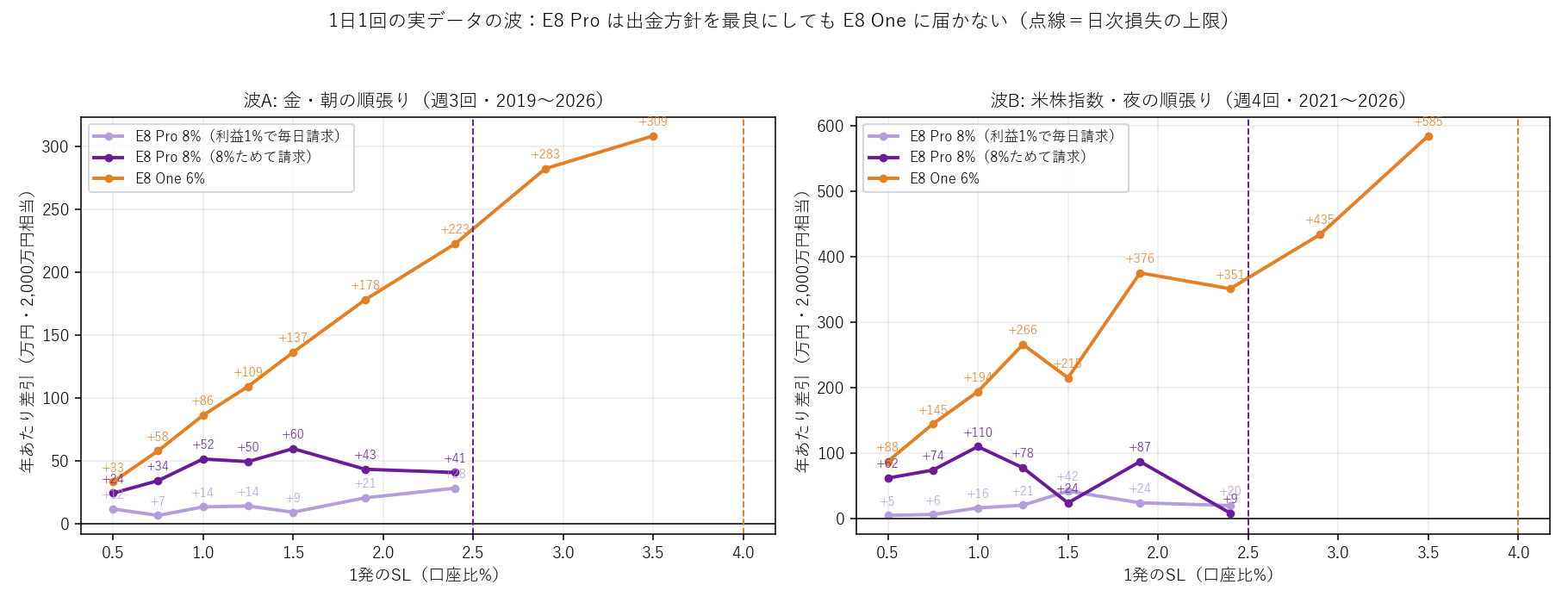
We used two "waves" we run on this site — the once-a-day style of entering at a set time of day and closing at a set time. Wave A is a morning trend-following gold strategy (3x/week, 2019–2026, 1,136 trades). Wave B is an evening trend-following US stock index strategy (4x/week, 2021–2026, 1,077 trades). Both use real M1/M5 prices, measured real spreads, a fixed price-based stop loss, an account equivalent to ¥20M, and a re-buy 7 days after failure. Pro's payout policy is tested two ways — "request daily at 1%" and "accumulate to 8% before requesting" — while One requests the full amount every 14 days as long as the 40% consistency rule is satisfied.
| Stop loss | Pro (daily @1%) Wave A | Pro (accumulate to 8%) Wave A | One 6% Wave A | Pro (daily @1%) Wave B | Pro (accumulate to 8%) Wave B | One 6% Wave B |
|---|---|---|---|---|---|---|
| 0.5% | +¥120K | +¥240K | +¥330K | +¥50K | +¥620K | +¥880K |
| 1.0% | +¥140K | +¥520K | +¥860K | +¥160K | +¥1.10M | +¥1.94M |
| 1.5% | +¥90K | +¥600K | +¥1.37M | +¥420K | +¥240K | +¥2.15M |
| 1.9% | +¥210K | +¥430K | +¥1.78M | +¥240K | +¥870K | +¥3.76M |
| 2.4% (Pro's cap) | +¥280K | +¥410K | +¥2.23M | +¥200K | +¥90K | +¥3.51M |
| 3.5% (One's best) | — | — | +¥3.09M | — | — | +¥5.85M |
Per year, on an account equivalent to ¥20M. One beats Pro at every lot size, and even against Pro's best policy (accumulate to 8% then request), it's +¥860K vs +¥520K for Wave A at 1.0%, and +¥3.76M vs +¥870K for Wave B at 1.9%. Comparing the best of each: +¥3.09M vs +¥630K, and +¥5.85M vs +¥1.37M.
Why such a large gap? We measured exactly how much the 2% cap shaves off.
| Stop loss | Wave A: excess-over-2% as % of winning-day profit | Days over 2% | Wave B: same | Days over 2% |
|---|---|---|---|---|
| 1.0% | 11% | 11/597 days | 8% | 21/569 days |
| 1.5% | 17% | 19/597 days | 14% | 55/569 days |
| 1.9% | 21% | 26/597 days | 19% | 95/569 days |
| 2.4% | 25% | 44/597 days | 27% | 159/569 days |
"Big days," which are only 2–28% of all winning days, hold 8–27% of total winning-day profit. Cut those off at 2%, and this shape of P&L stops working. One has no such cap, and since its 40% consistency rule only holds payouts rather than confiscating profit, the profit itself stays intact.
There's also a second hole in Pro. Requesting daily at 1% leaves you with only +¥120K–280K on Wave A and +¥50K–420K on Wave B. Switching to "accumulate to 8% first" scales that up 2–4x, but it's still less than half of One. Using Pro for spiky P&L means paying twice — once from the cap, once from losing the buffer on payout.
Which should you buy
Buy Pro if you:
- Fire 3+ times a day, and daily P&L stays within ±1–2%. Scalping, high-frequency EAs, time-distributed day trading
- Don't want to think about consistency rules, minimum trading days, or news restrictions at all
- Are fine with a payout policy of "accumulate to 8%, then take half." You can cut lot size in half after requesting
Buy One if you:
- Trade once a day, or with few trades, and most of your annual profit comes from a handful of big days. Session-based trend-following, breakouts, trend-following in general
- Don't mind a payout being held right after a big day (the profit stays intact)
- Want to hit +6% quickly and lock the floor at the starting balance
Configuration
- For Pro, choose 8% DD ($488 → $366). 6% DD ($468) has the same buffer width for a lower target — no benefit. 10% DD ($539) raises the target to 10% too, and loses across every edge level. The 100% split add-on (+$98) pays for itself at $490 in total profit, so add it if you're confident you'll pass
- For One, choose 6% DD, 80% split ($488 → $366). 8% DD ($586) costs 20% more without scaling the multiple up. The split add-on follows the same logic as Pro
If you're unsure: line up your last 100 trades' daily P&L and count how many days exceeded +2%. Zero → Pro. Five or more → One. That's your answer.
FAQ
Q. One's dynamic DD is described as "trailing" — why is it more stable than Pro's static drawdown?
One's floor stops at the starting balance. Once you're up 6%, the floor locks at the starting balance, and from that point on it behaves like a static account. Pro's floor jumps to the starting balance the moment you request your first payout, so after that payout, both accounts end up with "floor = starting balance." The difference is that One lets you claim the full amount, while Pro only lets you claim 50%, leaving the rest as your buffer.
Q. Isn't Pro's 2% cap fine as long as you trade with discipline?
For smoothed P&L, yes, no problem. In Monte Carlo, disciplined trading that "never targets a take-profit that would exceed the day's remaining cap" lost almost nothing. The issue is P&L shapes that discipline can't avoid — that is, strategies where a single trade can exceed +5%. Splitting trades or straddling days to dodge it is explicitly banned.
Q. Can One's 40% consistency rule actually block payouts?
It can hold them. For example, if you earn $3,000 in a single day out of $5,000 total period profit, the best day is 60%, so the payout is held until period profit reaches $7,500. But the profit isn't erased, and you don't fail the account. In our real-data waves, One's number of payouts dropped to 1–2 per year, but the money itself stays intact.
Q. Is it worth buying both?
Yes. For $732, you could run "smoothing strategies on Pro" and "spiky strategies on One" separately, matching each strategy to the container that fits it. Putting the same strategy in both is wasteful, since it will always be a poor fit for one of the two.
Q. What about E8 Signature?
That one has an EOD dynamic DD of 3–4%, no overnight carry, a payout cap, and a 35% consistency rule — an even narrower container than either plan discussed here. Think of it as strictly for intraday scalping.
Assumptions and limitations of this test
- Rules and prices were measured on the official site on September 13, 2026 (see E8 Markets guide). The 25% off code
E8was confirmed at checkout the same day. If it expires, the multiple drops by 25% at the $488 list price - Monte Carlo treats each trade's P&L as independent and doesn't include spread, slippage, or news. Fixed at 3 trades/day
- The real-data waves are strategies we run on this site; the instrument, day of week, and time of day are kept confidential. The stop loss is fixed in price terms, and only the per-trade risk (as a % of the account) was varied
- Pro's payouts are modeled as "request 50% on the day profit reaches the threshold, floor = starting balance from then on." One is modeled as "request the full amount every 14 days if the 40% consistency rule is satisfied." One's real payouts are on-demand (as soon as roughly 3 days after Performance starts), so in real use, One's payout frequency could be pushed even higher
- One's dynamic DD is modeled as tracking "the highest confirmed balance," updated daily since the waves trade once a day. It doesn't move on intraday floating profit
- Re-buying after a fail is modeled as one account, 7 days later. In practice, the decision of whether to re-buy has a large effect on the outcome
Sources
- E8 Markets official: pricing simulator (measured September 13, 2026), help articles "Daily profit cap" (articles/15319043), "Payout request from E8 Pro" (articles/13653464), and the articles on E8 One's Dynamic Drawdown and consistency rule
- This site: E8 Markets guide, Is E8 Pro worth buying?
- Simulation:
scripts/sim-e8-pro.py(Monte Carlo), charts viascripts/plot-e8-pro.py. Real-data verification is not published
Related articles
Written by
Hosono P | the prop firm strategist
I buy challenges with my own money and record everything through to the payout. Recorded payouts: ¥6.1M in total from Fintokei, Fundora and Funded7, plus $4,776 from The5ers (as of September 2026). Author of the semi-discretionary EA "ELDRA".