Is Fintokei's SwiftTrader Plan a Trap for the Unwary? Cheap, Fast, and 90% — But It Recovers Its Fee Through a 60-Day, 3% Box, Measured Against the Same Strategy as StartTrader, FTMO, and E8 [September 2026]
※ This article is based on rules confirmed against Fintokei, FTMO, and E8 Markets' official sites and official help centers on September 20, 2026. The simulation uses two approaches — an idealized model and real trading data — and guarantees nothing about future performance; this is not investment advice. FTMO's pricing alone is third-party aggregated data (March 2026, USD).
Conclusion: overpriced for most people. Only worth buying if you "fire multiple times a day and stack up small 0.5% wins"
SwiftTrader is Fintokei's only 1-step plan. A ¥20M account costs ¥93,800, cheaper than the same-size challenge plan (ProTrader) at ¥109,800. The target is 6%, and the split is 90%. "Cheap, fast, and you keep more" — all three at once is exactly the kind of pricing that pulls in first-timers.
Once we ran the numbers, all three of those things turn out to be built by shrinking the bucket.
- The loss allowance is a third the size. Overall loss is -3% (versus -10% on the challenge plan). Fee per ¥10,000 of allowance is ¥1,563 versus ¥549 — 2.85x. Only the sticker price is cheap
- Target ÷ loss allowance is 2.0 (versus 0.8 on the challenge plan's Phase 1). It's designed to make you earn 6% while only being allowed to lose 3% — heavier than Moneta's 1-Step at 1.67
- The 60-day time limit manufactures rebuys. Running a real "once-a-day" strategy through it, without ever blowing up, the account still expires 5 times a year, taking ¥93,800 with it each time
- Even after passing, you're still stuck inside the 3% box. The -3% overall loss stays in place after certification, and withdrawals stay locked until you hit "+3% per cycle"
- Run the same strategy through the other buckets, and you get 3-4x more. The challenge plan, FTMO 2-Step, and E8 One all deliver 3-4x SwiftTrader's best-case annual net over the same trading data
There's exactly one scenario where this plan actually has value: a high-frequency, high-win-rate method that fires 3+ times a day and stacks up wins of 0.5% or less per trade. For everyone else — and especially anyone who trades once a day with a stop-loss of 1%+ — this product is structurally a trap for the unwary. It looks cheap, fast, and generous, but the 60-day window and the 3% box recover the fee right out of your pocket.
What changed on July 15, 2026
SwiftTrader was completely overhauled on July 15, 2026. The official help center lays out a before-and-after comparison.
| Before (through July 14, 2026) | After (from July 15, 2026) | |
|---|---|---|
| Profit target | 10% | 6% |
| Daily loss rate | -3% | -2% |
| Overall loss rate | -6% | -3% |
| Evaluation period | Unlimited | Max 60 days |
| Split rate | 100% | 90% (100% for Diamond only) |
| Daily profit cap during evaluation | — | 3% |
| ¥20M price | — | ¥93,800 |
The target dropped, and so did the price, but in exchange the loss allowance was cut in half, a time limit was added, and the split dropped too. True to its "swift" name, this revision committed fully to a design built around passing fast and recovering the fee fast.
Note that the official help article "How are the Daily loss limit and Maximum Loss limit calculated?" (updated March 17, 2026) still says today that "SwiftTrader is daily 3%, overall 6%." That's just the old description left over — the purchase page and the revision announcement (updated July 15) say 2% / 3%. Don't buy based on the old numbers.
Lining up six buckets (officially confirmed)
Besides the Fintokei challenge plan, our comparison set includes the veteran FTMO (2-Step / 1-Step) and the 1-step crowd's E8 Markets (Pro / One). All are matched at $100K equivalent (¥20M converted).
| SwiftTrader | Challenge | FTMO 2-Step | FTMO 1-Step | E8 Pro 8% | E8 One 6% | |
|---|---|---|---|---|---|---|
| Steps | 1 | 2 (8→6%) | 2 (10→5%) | 1 (10%) | 1 (8%) | 1 (9%) |
| Daily loss | -2% (equity) | -5% | -5% (from initial balance, based on that day's opening balance) | -3% | -2.5% | -4% |
| Overall loss | -3% static | -10% static | -10% static | -10% EOD trailing (follows the highest balance) | -8% static (moves to initial balance at first withdrawal) | -6% dynamic (follows the highest confirmed balance, locks at initial balance) |
| Time limit | 60 days | None | None | None | None | None |
| Minimum trading days | 3 | 3 per phase | 4 per phase | None | None | 1 |
| Profit cap / consistency | 3% daily during evaluation / +3% per withdrawal cycle | None | None | 50% best-day | 2% daily (excess deleted), withdrawal capped at 50% of profit | 40% consistency at Performance stage |
| Split | 90% | 80% | 80→90% | 90% | 80% | 80% |
| Fee (% of account) | 0.469% (¥93,800) | 0.549% (¥109,800) | 0.540% ($540) | 0.499% ($499) | 0.366% ($488→$366 with code E8) | 0.366% (same) |
| Fee per ¥10,000 of loss allowance | ¥1,563 | ¥549 | ¥540 | ¥499 | ¥458 | ¥610 |
| Target ÷ loss allowance | 2.0 | 0.8 (Phase 1) | 1.0 (Phase 1) | 1.0 | 1.0 | 1.5 |
Only SwiftTrader is off the charts on the per-dollar price of loss allowance. E8 One's allowance is narrow at 6%, but its per-dollar price is ¥610 — only 40% of SwiftTrader's — and its target ÷ loss allowance sits at a reasonable 1.5.
Reading the bucket through three numbers
1. Fee per ¥10,000 of loss allowance. SwiftTrader's 3% allowance on ¥20M is ¥600,000, against a fee of ¥93,800 → ¥1,563 per ¥10,000. The challenge plan's 10% allowance is ¥2M against ¥109,800 → ¥549. FTMO is ¥540, E8 Pro ¥458, E8 One ¥610. The sticker price makes SwiftTrader look cheapest, but divide by the "amount you're allowed to lose," and you're paying 2.5-3.4x more than every other firm.
2. Target ÷ loss allowance. SwiftTrader is 6% ÷ 3% = 2.0. The challenge plan is 8% ÷ 10% = 0.8, FTMO and E8 Pro are 1.0, and E8 One is 1.5. "Earn twice what you're allowed to lose" is unique to SwiftTrader among these six.
3. How much you can fire in a day. The -2% daily loss is equity-based, so if you're taking 3 shots a day, the ceiling per trade is 0.66% (three losses in a row = -1.98%). Even at one shot a day, the ceiling is 1.9%, and at that level your second stop-loss blows through the -3% overall limit. The challenge plan and FTMO 2-Step both have a 5% daily loss, so at one trade a day you can size up to 4.9%. SwiftTrader's leverage is also just 25x, so building large positions isn't even structurally possible.
Monte Carlo: high-frequency traders firing 3x a day do have a region where SwiftTrader wins
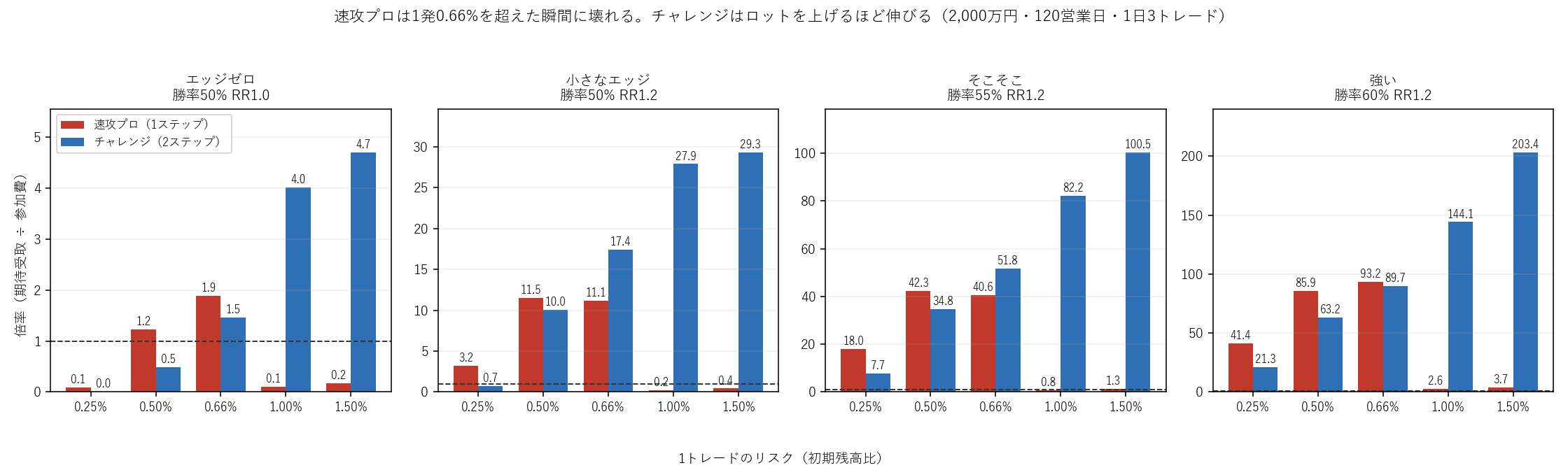
Run across 40,000 Monte Carlo paths, each trade wins at rate p for +R×r, or loses -r. 3 trades per day, 120 trading days. Once you pass the evaluation you enter Funded, with a payout decision every 10 trading days (biweekly). For SwiftTrader we impose "can't withdraw unless you've hit +3%," "the 60-day (42 trading day) window expires," and "capped at +3% daily during evaluation." For the challenge plan there's no time limit, no withdrawal condition, and no profit cap.
Multiplier = expected payout ÷ fee. 1.0x is break-even.
| Skill | Risk/trade | SwiftTrader multiplier | Days to pass | Fail rate | Challenge multiplier | Days to pass | Fail rate |
|---|---|---|---|---|---|---|---|
| Zero edge, 50%, RR1.0 | 0.50% | 1.23 | 24 days | 98.6% | 0.49 | 82 days | 34.9% |
| 0.66% | 1.88 | 19 days | 99.5% | 1.46 | 70 days | 54.2% | |
| 1.50% | 0.16 | — | 100% | 4.71 | 25 days | 98.5% | |
| Small edge, 50%, RR1.2 | 0.50% | 11.54 | 20 days | 88.3% | 10.04 | 67 days | 6.7% |
| 1.00% | 0.25 | — | 100% | 27.88 | 33 days | 59.6% | |
| 1.50% | 0.44 | — | 100% | 29.33 | 18 days | 88.9% | |
| Decent, 55%, RR1.2 | 0.50% | 42.26 | 17 days | 56.1% | 34.78 | 46 days | 0.4% |
| 1.50% | 1.40 | — | 100% | 100.49 | 14 days | 55.2% | |
| Strong, 60%, RR1.2 | 0.50% | 85.90 | 13 days | 25.5% | 63.22 | 30 days | 0.0% |
| 0.66% | 93.23 | 10 days | 53.6% | 89.71 | 24 days | 0.2% | |
| 1.50% | 4.07 | — | 100% | 203.37 | 11 days | 21.6% |
At the same lot size, SwiftTrader wins below 0.5%. It passes faster (13-20 days versus 30-67 days), pays out 90%, and the fee is cheaper. The instant you go past 1% per trade, SwiftTrader breaks down (100% fail rate). If you're free to pick your own lot size, the challenge plan wins across every skill level (best-case comparisons: 4.7x vs. 1.9x, 29x vs. 11.5x, 100x vs. 42x, 203x vs. 93x).
But this is all under the assumption that you can fire 3 times a day. Next, we run the same test with a real once-a-day strategy.
Real data: run a once-a-day strategy through six buckets, and SwiftTrader comes in second-to-last
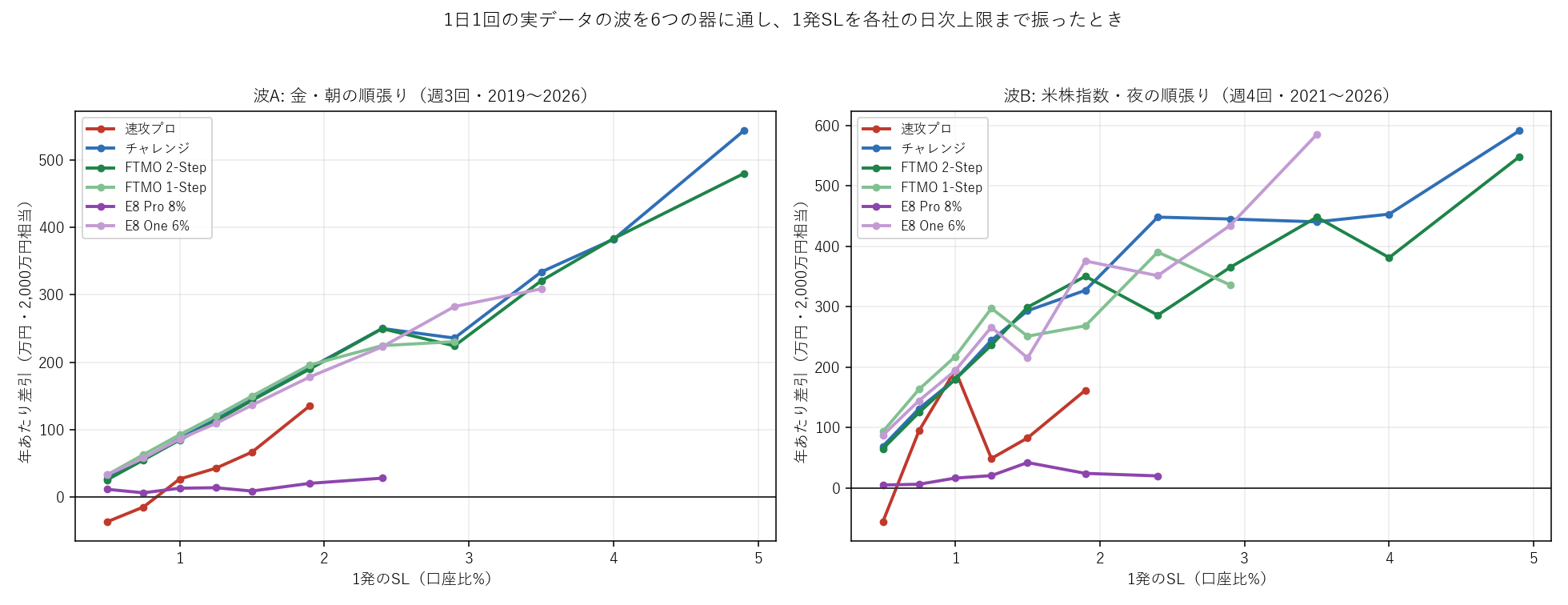
We used two "trade once a day at a set time and close at a set time" strategies we actually run. Strategy A trades gold in the morning, trend-following (3x/week, 2019-2026, 1,136 trades). Strategy B trades US stock indices at night, trend-following (4x/week, 2021-2026, 1,077 trades). Both use real M1/M5 prices and measured spreads, with the stop-loss fixed on a price basis; only the per-trade risk (as a % of the account) is swept up to each firm's daily cap. On a failure or expiry, we rebuy 7 days later; the account size is ¥20M equivalent.
| Bucket | Strategy A best point | Annual | Payout ÷ fee | Blowups / expirations | Strategy B best point | Annual | Payout ÷ fee | Blowups / expirations |
|---|---|---|---|---|---|---|---|---|
| SwiftTrader | SL 1.9% | +¥1.36M | 3.6x | 14 / 28 | SL 1.0% | +¥1.95M | 6.4x | 13 / 6 |
| Challenge | SL 4.9% | +¥5.43M | 39x | 9 / 0 | SL 4.9% | +¥5.91M | 7.8x | 40 / 0 |
| FTMO 2-Step | SL 4.9% | +¥4.80M | 32x | 10 / 0 | SL 4.9% | +¥5.48M | 8.0x | 38 / 0 |
| FTMO 1-Step | SL 2.9% | +¥2.31M | 26x | 7 / 0 | SL 2.4% | +¥3.90M | 13x | 16 / 0 |
| E8 Pro 8% | SL 2.4% | +¥280K | 4.7x | 8 / 0 | SL 1.5% | +¥420K | 3.0x | 14 / 0 |
| E8 One 6% | SL 3.5% | +¥3.09M | 28x | 11 / 0 | SL 3.5% | +¥5.85M | 16x | 27 / 0 |
And, running the earlier "SwiftTrader wins" case, 0.5% risk per trade:
| Bucket | Strategy A, 0.5%, annual | Expirations | Strategy B, 0.5%, annual | Expirations |
|---|---|---|---|---|
| SwiftTrader | -¥360K | 40 | -¥560K | 28 |
| Challenge | +¥280K | 0 | +¥690K | 0 |
| FTMO 2-Step | +¥260K | 0 | +¥650K | 0 |
| E8 One 6% | +¥330K | 0 | +¥880K | 0 |
Three takeaways here.
At 0.5% risk once a day, SwiftTrader never reaches 6% within 60 days. Strategy A expired 40 times over 7.7 years, Strategy B 28 times over 5.2 years. Without ever blowing up, ¥93,800 vanishes every time a quiet couple of months rolls around. Every other bucket stays in the black at the same lot size. What the Monte Carlo showed as "SwiftTrader wins at 0.5%" only holds if you can fire 3 times a day.
SwiftTrader's best point is a setting that dies on its second stop-loss. Strategy A's best point is 1.9%, netting +¥1.36M a year, but that's after paying for 14 blowups + 28 expirations = 42 rebuys (¥3.94M). Strategy B's best point is 1.0%; push it to 1.25% and blowups double from 13 to 26, dropping the annual net to +¥490K. The optimal point is narrow, and missing it cuts the result in half. The challenge plan and FTMO 2-Step climb monotonically from 1.0% all the way to 4.9%.
Pushed to their respective limits, the challenge plan comes in at 4x SwiftTrader. +¥5.43M vs. +¥1.36M on Strategy A, +¥5.91M vs. +¥1.95M on Strategy B. FTMO 2-Step is nearly identical (+¥4.80M / +¥5.48M). E8 One, despite its narrow 6% bucket, comes in at +¥3.09M / +¥5.85M — its cheap per-dollar price and 1.5 target-to-allowance ratio are doing the work. E8 Pro comes in last of all six (+¥280K / +¥420K), because its "2% daily profit cap" strips out the big days and the max-loss line moves up to the initial balance at first withdrawal.
Passes once, but doesn't survive
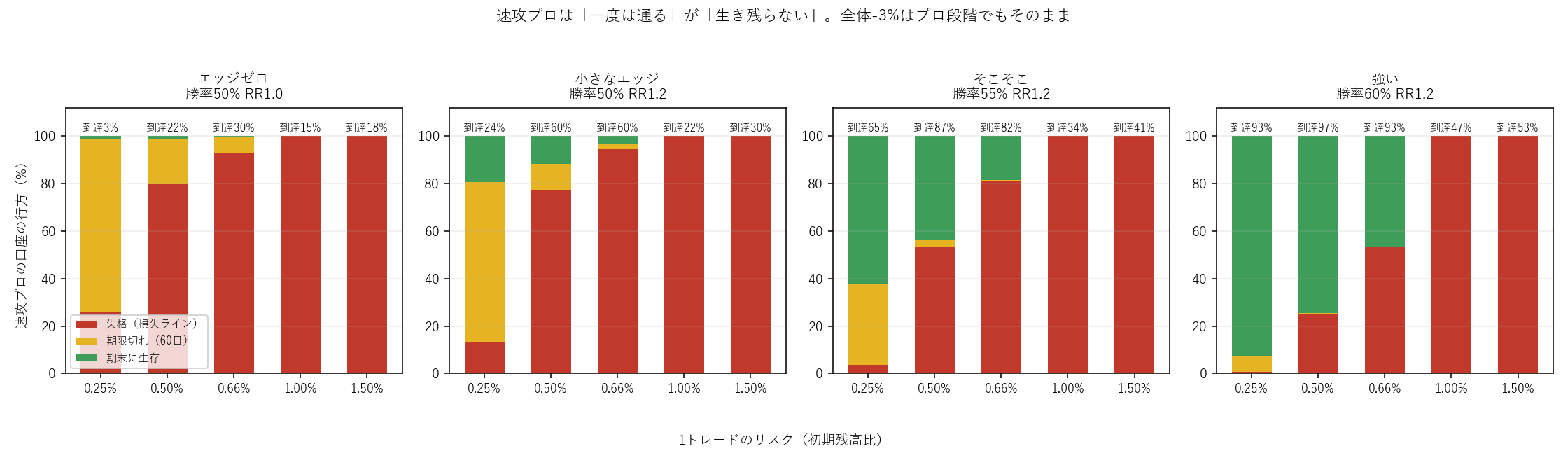
What catches the eye in SwiftTrader's numbers is that the fail rate is high even where the multiplier looks decent. At the Monte Carlo's 55% win rate and 0.5% risk, the fail rate is 56%; at 50% win rate/RR1.2 and 0.5%, it's 88%. And yet the multipliers there are 42x and 11.5x.
The reason is "it passes fast, and cashes out a few times before dying." SwiftTrader's -3% overall loss stays in place even after certification, so eventually a day comes where you lose 3%. But because certification comes in just 13-20 days, and you can withdraw biweekly, you average 1-4 withdrawals before dying. SwiftTrader's value isn't determined by "how long the account survives" but by "how fast you get certified × how many times you withdraw before it ends." That's the structure here.
Conversely, if you reduce lot size, expiration becomes the dominant cause of failure instead. "Play it safe and small" doesn't work with SwiftTrader. To hit 6% within 60 days, you need roughly enough lot size to use up the daily allowance.
Six pitfalls
1. The -3% overall loss doesn't move, even at the Pro stage. The official help article "Rules for maintaining a SwiftTrader account" states: "Max loss -3% static, daily -2% equity." Even after passing, a 3% loss ends the account.
2. The -2% daily loss is equity-based. The instant your equity drops 2% from its value at 00:00 UTC, you fail — floating losses count. Swing strategies that hold through floating losses are always exposed to failing overnight the moment they touch 2%.
3. There's a "+3% profit target" attached to every withdrawal. The purchase page states "profit target per payout: +3%," and the help center states withdrawals unlock once you hit the "Minimum profit per payout." Even after certification, this target doesn't go away — you have to keep producing +3% (78% annualized) every cycle for withdrawals to stay open. Periods where you don't hit it just accumulate, and if you touch -3% in the meantime, it all resets. The challenge plan, FTMO, and E8's Pro stages have no such profit target.
4. During evaluation, daily profit is capped at 3%. As a consistency rule: "max daily profit 3% (evaluation phase only)." You can't take 6% in a single day and pass the next day — it takes at least 3 days minimum. There's no such cap at the Pro stage. During evaluation the constraints are loss of -2%/-3% and profit +3%; at the Pro stage it's loss of -3% and a +3% target per withdrawal. At every stage, SwiftTrader keeps you trading inside a box bounded by 3%.
5. The 60-day window. That's 42 trading days. At 0.5% risk once a day, you won't make it in time, leading to 5 rebuys a year.
6. Leverage is 25x. A quarter of the challenge plan's 100x. Since the loss allowance is narrow, the real-world impact is small, but methods that build large positions in gold or indices simply don't fit here.
Who is this "worth it" for?
Worth it (a minority)
- Traders who fire 3+ times a day and stack up 0.3-0.5% per trade. High-win-rate scalping, time-window-limited high-frequency EAs. This is the only region where SwiftTrader is more efficient than the challenge plan
- Someone who specifically wants a fast first withdrawal using that method. Certification in 13-20 days, first withdrawal in as little as two weeks
- Someone who's fine with the account ending once they've recovered the fee. Its lifespan is short
Not worth it (most people)
- Once-a-day traders. At 0.5% you expire, at 1%+ you blow up. On real data, -¥360K to -¥560K a year at 0.5%. Strategies that stay in the black on the challenge plan, FTMO 2-Step, and E8 One all turn negative on SwiftTrader alone
- Discretionary traders using 1%+ risk per trade. 100% fail rate in the Monte Carlo
- Swing traders who carry floating losses. You're exposed to the -2% equity daily limit overnight
- Anyone choosing it for "it's cheap," "it's 1-step," or "it's 90%." Those three things are exactly what the shrunken bucket paid for
If you're going to buy something, what instead
At the same ¥20M class, ranked by what the real-data strategies showed: challenge plan (¥109,800) ≈ FTMO 2-Step ($540) > E8 One 6% ($366) > FTMO 1-Step ($499) ≫ SwiftTrader (¥93,800) > E8 Pro 8% ($366).
- Want everything to work entirely in Japanese: Fintokei's ¥20M challenge plan. Cheapest as a share of account size (0.549%), a 10% bucket, no time limit
- Track record and refunds: FTMO 2-Step. Nearly the same rules as the challenge plan, and the fee comes back after passing
- Confident you can trade within a 6% bucket while keeping the fee low: E8 One 6% ($366 with code E8). The dynamic DD locks at the initial balance, so once you're up 6%, it behaves the same as static from then on
- If there's any reason to buy SwiftTrader: firing 3+ times a day at 0.5% or less per trade, and buying just one ¥20M (0.469%) account. Cap your per-trade risk at 0.5%, and go in assuming the account's life ends once the fee is recovered
FAQ
Q. What happens to accounts bought before the revision?
The official help center lists "accounts purchased before July 15, 2026" separately, keeping the old 10% target / 3% daily / 6% overall rules. Buying again puts you on the revised rules.
Q. Why is E8 Pro so weak here?
Because of the "2% daily profit cap" — anything above that gets deleted from the account the next day. Once-a-day strategies typically make their money on a handful of big days each year, and cutting those off leaves little behind. On top of that, requesting a first withdrawal raises the failure line to the initial balance, and only half the profit can be withdrawn. We covered this in detail in the E8 Pro article.
Q. FTMO 1-Step is also a single step like SwiftTrader — what's different?
The bucket is 10% (versus SwiftTrader's 3%), no time limit, and -3% daily. In exchange, max loss is an EOD trailing line that follows the highest balance, so the failure line rises as profit builds. On real data, it produced +¥2.31M (Strategy A) and +¥3.90M (Strategy B) — 1.7-2x SwiftTrader. If you want a 1-step plan, FTMO 1-Step or E8 One beats SwiftTrader.
Q. How does this compare to Moneta's 1-Step?
Moneta 1-Step has a 10% target, 6% max loss, 3% daily loss, for a target ÷ loss allowance of 1.67. SwiftTrader is 2.0 — even heavier — plus the 60-day window. Fees are close: SwiftTrader's ¥20M is 0.469%, and Moneta 1-Step's $100K is $420 (0.42%, at 50% off). The bucket is heavier on SwiftTrader; the price is about the same.
Q. Can I use an EA?
The purchase page says "EA usage OK." However, Fintokei bans using off-the-shelf or free EAs without adjustment — it must be self-made or something you've tuned the parameters of yourself (see the Fintokei guide). A self-made, high-frequency, low-lot-size EA is one of the few combinations where SwiftTrader becomes "worth it."
Q. Does the 3% rule also apply to SwiftTrader?
Yes. "Maximum permitted risk on open positions: -3%." Since the overall loss allowance is also 3%, this effectively means "the combined risk of your open positions can't exceed the entire remaining bucket." A violation isn't an instant failure — it triggers a warning followed by the consistency rule, according to the help center.
Assumptions and limits of this analysis
- Fintokei's rules and pricing were confirmed on September 20, 2026 against the official purchase pages (/jp/swifttrader, /jp/protrader) and the official help center. Only the help article "How are the Daily loss limit and Maximum Loss limit calculated?" still shows the pre-revision figures
- FTMO's rules come from the official Trading Objectives page (2-Step: 10% static max loss, 5% daily loss from that day's opening balance; 1-Step: 10% max loss as EOD trailing, 3% daily loss, 50% best-day rule). FTMO's pricing ($100K 2-Step $540 / 1-Step $499) is third-party aggregated data (PropFirm Key, March 11, 2026), since the official page's price table couldn't be scraped due to JS rendering
- E8's rules come from our full survey on September 13, 2026 (E8 Pro: static 8%, 2.5% daily, 2% daily profit cap with excess deleted, withdrawal capped at 50% of profit, failure line moves to initial balance at first withdrawal; E8 One: dynamic 6%, 4% daily, 9% target, 40% consistency at Performance stage). Pricing is $366 after code E8
- The Monte Carlo assumes each trade's P&L is independent and doesn't include spread, slippage, swap, or news. It's fixed at 3 trades a day, so it doesn't apply to once-a-day strategies — the real-data check in the body of this article corrects for that
- The real-data strategies are ones we run ourselves; the symbol, day of week, and time of day are withheld. The stop-loss is fixed on a price basis, with only per-trade risk (as a % of account) varied. Since these strategies trade once a day, 3-4x a week, results for high-frequency methods will differ
- "+3% per withdrawal" was modeled as "if profit relative to the initial balance reaches +3% by the end of the cycle, withdraw the full amount." "3% daily profit cap" was applied only during evaluation. E8 One's 40% consistency was modeled as "withdraw if the best day in the cycle is 40% or less of total profit; otherwise carry it forward"
- Rebuys happen once, 7 days after a failure or expiration. In reality, the decision of whether to rebuy is what determines the outcome
- The Scaling Dojo and XP-based fee refunds and 100% split aren't modeled, since their conditions aren't publicly disclosed
Sources
- Fintokei: SwiftTrader plan purchase page (fintokei.com/jp/swifttrader), Challenge plan purchase page (/jp/protrader), official help articles "How does SwiftTrader Challenge work? What are the rules?", "What rules do I have to follow to keep my SwiftTrader account?", "What leverage do you offer?" (updated July 15, 2026), "What is SwiftTrader program?" (updated July 15, 2026), "How are the Daily loss limit and Maximum Loss limit calculated?" (updated March 17, 2026, old figures)
- FTMO: ftmo.com/en/trading-objectives, /en/2-step-challenge, /en/1-step-challenge. Pricing from propfirmkey.com, "FTMO Challenge Cost 2026" (March 11, 2026)
- E8 Markets: E8 Markets guide, Is E8 Pro worth buying?
- Simulation:
scripts/sim-fintokei-swift-vs-pro.py(Monte Carlo), charts viascripts/plot-fintokei-swift-vs-pro.py. Real-data verification is not published.
Related articles
Written by
Hosono P | the prop firm strategist
I buy challenges with my own money and record everything through to the payout. Recorded payouts: ¥6.1M in total from Fintokei, Fundora and Funded7, plus $4,776 from The5ers (as of September 2026). Author of the semi-discretionary EA "ELDRA".