Buying Instant Pro for the Expected Value Is Close to Worthless | Jump In Because It's "Half Price" and, Costs Included, You Only Get Back 80% of What You Paid [Verification]
※ This article is a simulation-based verification. It is not investment advice. Prices and rules were measured on each firm's official screens on September 12, 2026.
Whether to buy a prop account can be decided with a single number, not a feeling: "how much is it worth paying for this account?"
Work out the expected payout and that number becomes the break-even fee. If the actual sale price is lower than that, buy it. If it's higher, it's overpriced. That's the whole framework.
I ran 40,000 Monte Carlo simulations on Moneta Instant Pro to back out this figure. The answer is 2.755% of the account. For a $100K account, that's $2,755.
The list price is $5,300. In other words, buying at list price means paying $5,300 for something worth $2,755. A multiple of 0.52x. You only get back half.
With the 50% OFF coupon at $2,650, it's finally 1.04x — essentially a fair trade. Add a 0.01% per-trade spread (about $10 on a $100K account, roughly 1 pip on 1 lot of EURUSD) and it falls to 0.82x. For the $2,650 you paid, you can expect $2,173.
Here's the conclusion up front: buying Instant Pro for the expected value is close to worthless. And "it's half price" is not a reason to buy. Half price isn't a discount you're benefiting from — it's an item priced at double its value finally settling back to fair.
Below, I lay this out next to the two-phase programs (Moneta 2-Step / Fintokei ProTrader) to show why.
TL;DR: If you're chasing expected value, Instant Pro is close to worthless
- Even at list price, the multiple is 0.52x. The maximum price worth paying is 2.755% of the account, yet the list price is 5.300%. You're paying double the value
- Even with 50% OFF, it's only 1.04x. Half price isn't "a deal" — it's just an overpriced item settling back to fair. There's almost no room left to gain from here
- With costs included, it's 0.82x. Just a 0.01% per-trade spread drops the maximum worth paying to 2.173%. You pay $2,650 and can expect $2,173 — 80% of what you paid
- The moment you buy, you start 3.01% behind on the account. The fee is 2.65% of the account, but you only get to keep 88% of profit, so you need to earn 3.01% just to break even. For the two-phase programs, it's 0.54%
- In other words, "I'm buying it because it's half price" is a decision that will almost certainly lose you money. Decide based on what the account is actually worth, not the discount percentage
- Under the same conditions, the two-phase programs return more than 3x. Moneta 2-Step comes in at 3.14x, Fintokei ProTrader at 3.11x. Even with only a ~30% pass rate, the much lower fee makes them win decisively on efficiency
- The multiple doesn't change even with an edge. Push win rate to 60% and the two-phase programs hit 183x and 171x, while Instant Pro reaches only 37x. The gap doesn't close — it widens
- Why is it so thin? In theory, a prop account is a call option (losses capped at the fee, upside uncapped), so it retains value even at zero edge. But for Instant, nearly all of that value has already been priced in
- The trailing drawdown adds insult to injury. Even at the same 8%, making it trailing rather than static raises the failure rate by up to 23.7 points. And it only matters until you reach +8% — after that, it becomes a normal static-DD account
- Conclusion: The only reason to buy Instant is "time." You're paying for being funded from day one and running the full 120 trading days. If you're choosing by expected value, pick the two-phase programs
The yardstick: the maximum price worth paying
The method is simple. For a trader with a given skill level, compute the expected payout at the end of the period. Zero if they fail, and profit times the split if they survive.
This expected payout is directly the break-even fee. If it comes out to $2,755, buying at $2,650 is expected-value positive; at $3,000 it's overpriced. That's it.
The method is expressed per trade: win rate p gives +R×r on a win, −r on a loss. r is the risk per trade (as a % of the account), R is the risk-reward ratio. 3 trades per day, 40,000 runs.
1. Positive even at zero edge — but thin
Start here. Even with a zero-edge coin flip (50% win rate, RR 1.0), the expected payout on the account is positive.
The reason is asymmetry. A loss only costs you the fee (the account's loss doesn't come out of your pocket). A win, however, is paid out at the profit split. In other words, this is structured exactly like a call option: losses capped, profits uncapped.
At $100K, 88% split, 1% risk per trade, 3 trades/day, over 60 trading days, the fair price for a zero-edge trader comes out to $2,751.
Here's the crux: the actual sale price is $2,650. The gap is only $101.
In other words, the 50%-OFF price of $2,650 is close to the fair price for a coin-flip trader. The seller isn't overcharging, and the buyer isn't clearly winning either. It's priced close to fair value.
Just how thin that margin is
This $105 margin (over 120 trading days) disappears as soon as you factor in real costs.
| Cost per trade | Instant Pro net | Moneta 2-Step net |
|---|---|---|
| 0.000% (theoretical) | +$105 | +$838 |
| 0.010% | −$477 | +$430 |
| 0.020% | −$1,050 | +$185 |
| 0.050% | −$2,128 | −$197 |
A cost of just 0.01% per trade — $10 on a $100K account — is enough to push Instant Pro into negative territory. That's about the level of slipping 1 pip on 1 lot of EURUSD.
Here's the takeaway. In theory, a prop account has value. But for Instant Pro, almost all of that value has already been taken back in the price. At list price it's double the value; at half price it's barely a fair trade; add in spread and it's 80%. What's left is the feeling of "I got it cheap" — not actual expected value.
From the moment you buy, you're 3.01% behind on the account
There's another point that's easy to overlook. The moment you pay the fee, the account starts out in the negative.
Say you buy a $100K Instant Pro account for $2,650. The account holds $100,000, but your wallet is already down $2,650. Until you fill that hole, growing the account doesn't actually mean you're winning yet.
The tricky part: $2,650 isn't enough to fill it.
The fee is 2.65% of the account. But because profit is only paid out at the 88% split, you need the account to earn $3,011 to recoup $2,650 in hand — a rate of 3.01%.
Fee ÷ (account size × profit split) = break-even $2,650 ÷ ($100,000 × 88%) = 3.01%
The profit split deepens the "hole" by a factor of 1.14. The hole you actually have to dig out of is deeper than the 2.65% printed on the price sheet.
How much this hole differs by program
Running the same math across three programs:
| Program | Fee (% of account) | Split | Break-even (% of account) |
|---|---|---|---|
| Moneta Instant Pro | 2.650% | 88% | 3.01% |
| Moneta 2-Step | 0.475% | 88% | 0.54% |
| Fintokei ProTrader | 0.467% | 80% | 0.58% |
Only Instant Pro has a hole more than 5x deeper. With the two-phase programs, earning about 0.5% of the account gets you even; with Instant Pro it's 3%.
And under the trailing drawdown, you're chasing this 3.01% while the failure line is climbing after you. In the stretch up to the +8% lock, 3.01% — 38% of the way — is spent just recouping the fee.
And if you buy at list price, this hole becomes 6.02%. You'd need to earn 6% on the account just to recover the $5,300. All the half-price coupon really does is shrink this hole from 6.02% to 3.01%.
2. What the trailing drawdown actually takes away
This is the real subject. I ran the same random sequence — literally the same trade sequence — through two drawdown rules side by side, changing only the drawdown mechanic. This isolates the cost of "being trailing" itself.
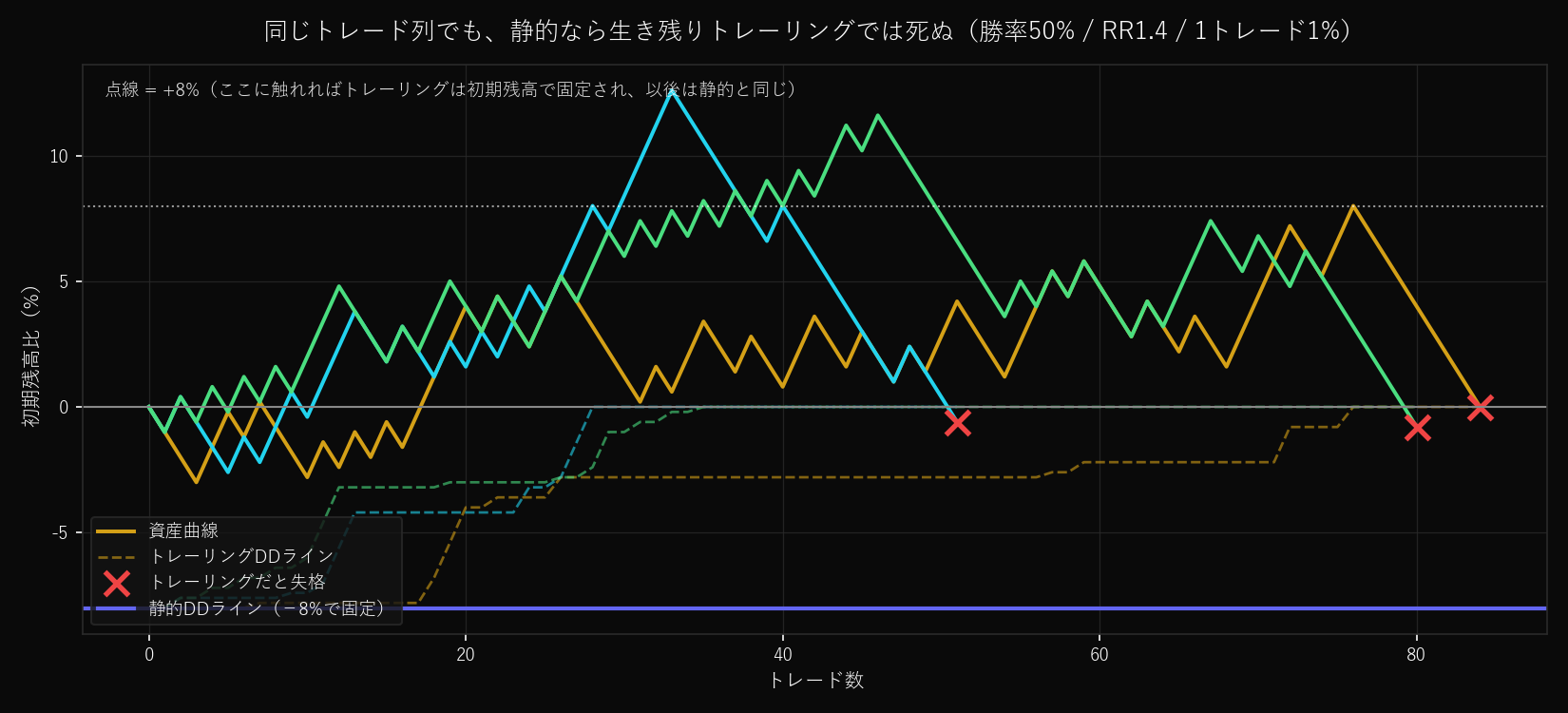
All three lines never once touch the static 8% line (the blue horizontal line). Yet all three failed under trailing. The middle one stretched to +12% before failing on a pullback below breakeven.
Floating profit isn't "money earned" — it's "the new position of the failure line." A strategy that stretches gains and gives them back repeatedly tightens the noose around its own neck every time it stretches.
The gap depends on the shape of the strategy
Fixing expected value per trade exactly at +0.20r, varying only win rate and RR.
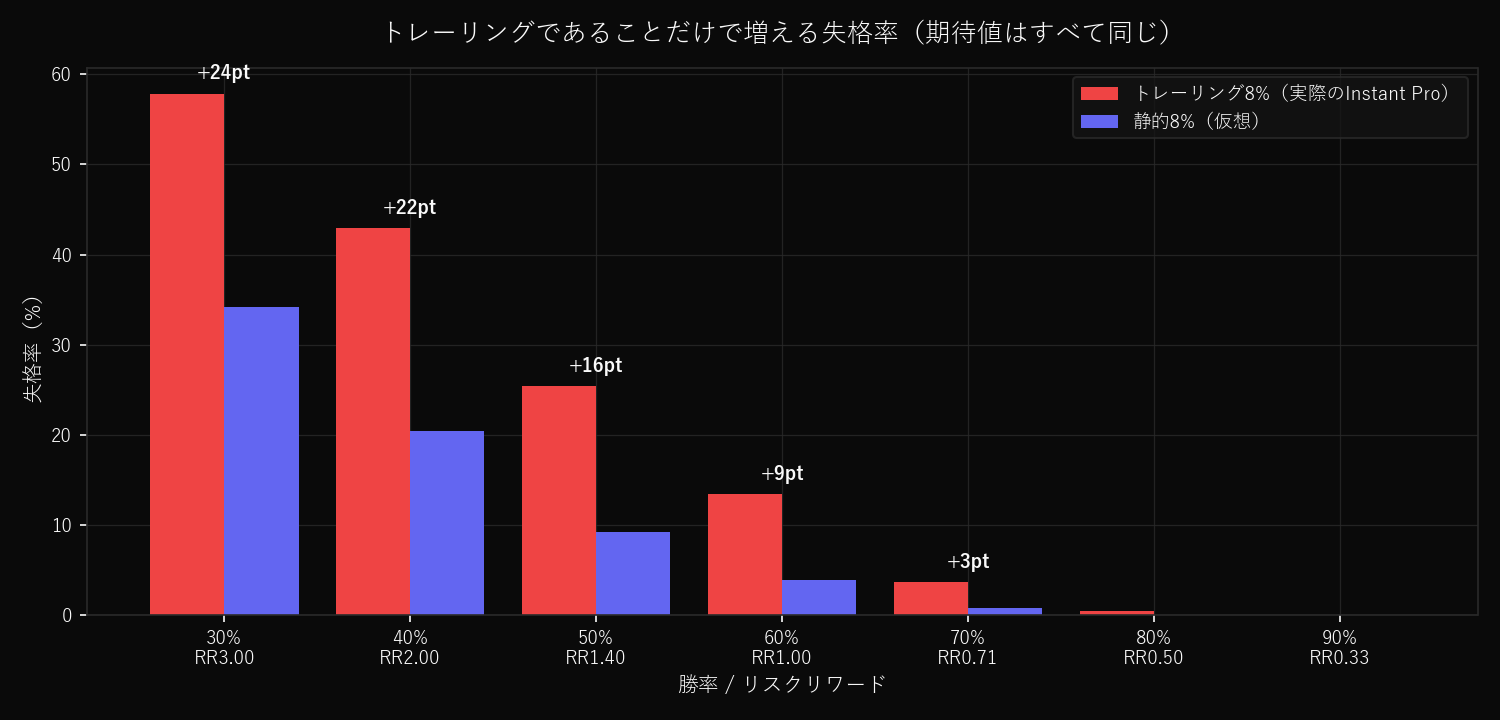
| Win rate | RR | Failure rate (trailing 8%) | Failure rate (static 8%) | Gap |
|---|---|---|---|---|
| 30% | 3.00 | 57.8% | 34.2% | +23.7pt |
| 40% | 2.00 | 42.9% | 20.5% | +22.5pt |
| 50% | 1.40 | 25.4% | 9.2% | +16.2pt |
| 60% | 1.00 | 13.4% | 3.9% | +9.5pt |
| 70% | 0.71 | 3.6% | 0.8% | +2.9pt |
| 80% | 0.50 | 0.5% | 0.1% | +0.4pt |
| 90% | 0.33 | 0.0% | 0.0% | ±0pt |
Expected value is identical on every row. Yet trailing takes 23.7 points of extra failure rate from the 30%-win-rate strategy, and almost nothing from anything above 80%.
Saying "trailing drawdown is disadvantageous" isn't quite accurate. The precise version is: trailing drawdown selectively kills only the choppy equity curves. A breakout style that cuts losses short and lets winners run is the worst possible fit for this mechanic.
The gap only exists on the way to +8%
The trailing line permanently locks once it reaches the initial balance. For a $100K account, it starts rising from $92,000 and stops at $100,000. In other words, once you've stretched to +8%, it becomes an ordinary static drawdown — "fail if you go below the initial balance" — from that point on.
So the gap only exists between 0% and +8%. 67–100% of failures happened before this lock.
Reducing lot size erases the trailing penalty too
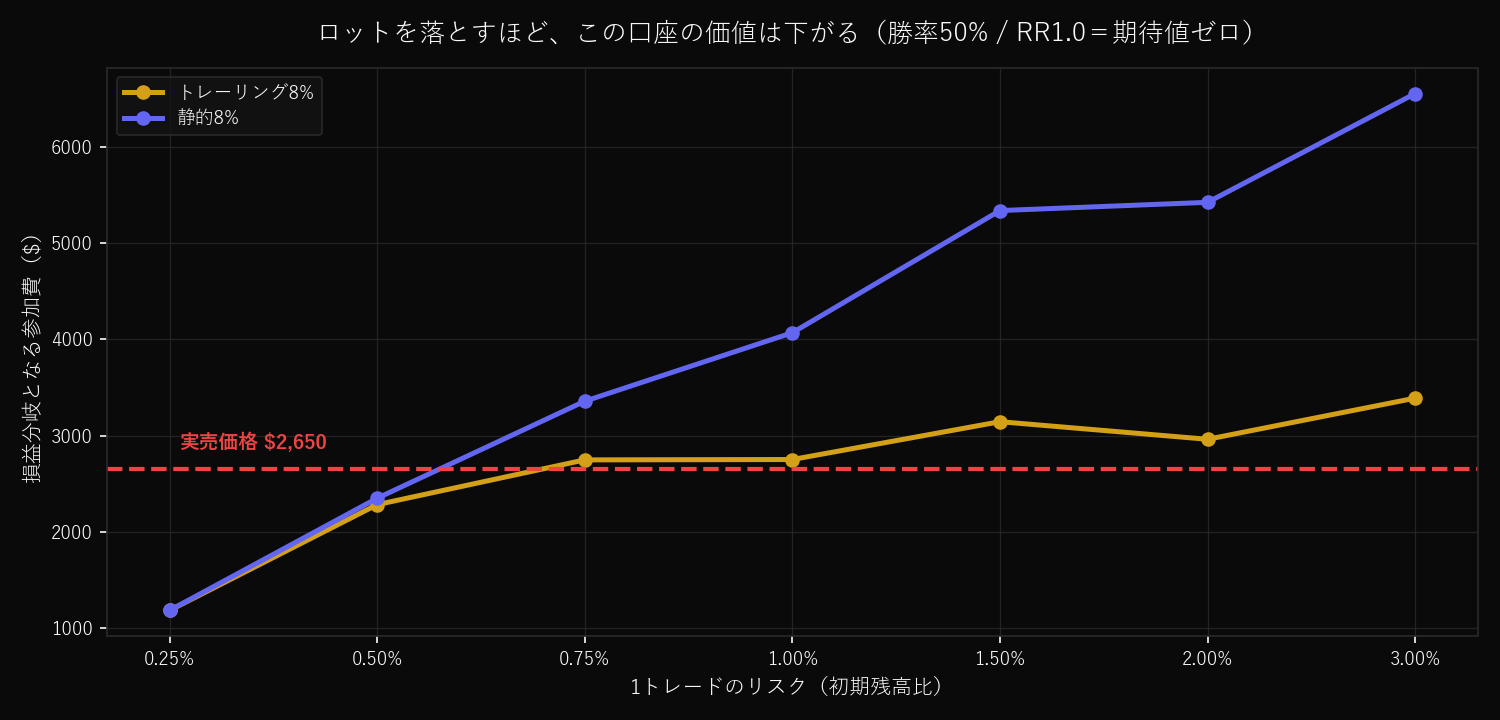
| Risk per trade | Max value, trailing | Max value, static | Trailing penalty |
|---|---|---|---|
| 0.25% | $1,183 | $1,183 | $0 |
| 0.50% | $2,282 | $2,348 | $66 |
| 0.75% | $2,747 | $3,357 | $610 |
| 1.00% | $2,751 | $4,068 | $1,317 |
| 2.00% | $2,961 | $5,423 | $2,462 |
If you're sizing small, trailing vs. static doesn't matter — the line simply doesn't catch up because you're not going up far anyway. Conversely, the bigger you size, the bigger the trailing penalty gets.
At the same time, though, sizing small also lowers the value of the account itself (at 0.25%, it's worth $1,183 — clearly overpriced against $2,650). You'd be paying for drawdown room you never use.
3. How much is it worth paying, given your own win rate and RR?
Look up your own numbers. Figures are for $100K, 88% split, 1% risk per trade, 3 trades/day, 60 trading days, trailing 8%.
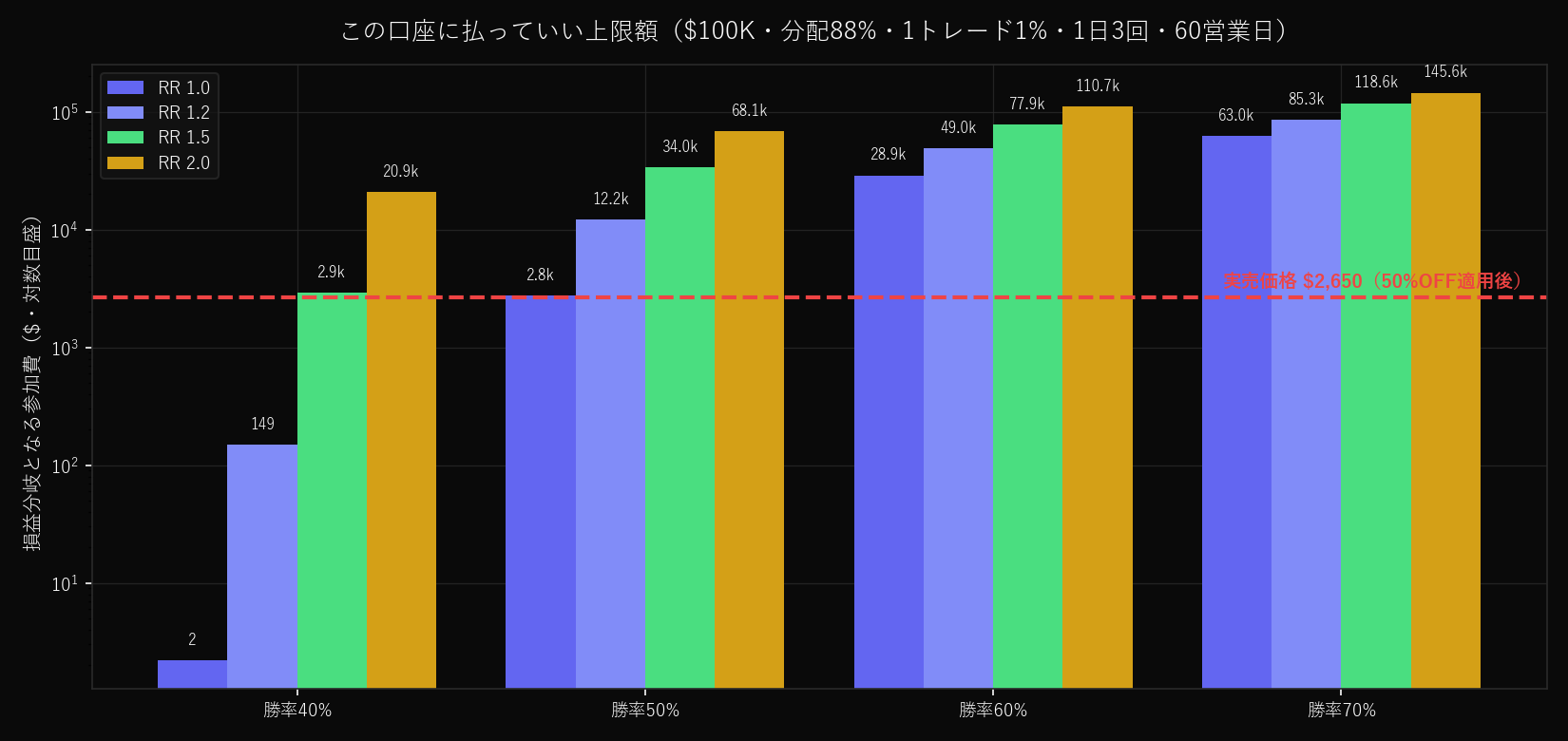
| Win rate | RR1.0 | RR1.2 | RR1.5 | RR2.0 |
|---|---|---|---|---|
| 40% | $2 | $149 | $2,896 | $20,941 |
| 50% | $2,751 | $12,214 | $33,972 | $68,144 |
| 60% | $28,907 | $48,960 | $77,946 | $110,674 |
| 70% | $63,002 | $85,349 | $118,646 | $145,640 |
The actual sale price of $2,650 sits just above the 50% win rate / RR1.0 line.
- At 40% win rate with RR1.2 or below, the value is essentially zero ($2 or $149). Don't buy
- Get to 50% win rate / RR1.2 and the value is $12,214 — 4.6x the price
- At 60% win rate or above, any RR puts you in a different order of magnitude
4. Instant, two-phase, and Fintokei side by side
Now let's compare against the evaluation-type programs. Since currencies differ, I've normalized both the fee and the max value to a percentage of account size. The period is 120 trading days across all programs, common to all. Instant is funded from day one, while evaluation types lose the days spent passing, and that difference shows up directly.
All prices are shown after discount. Mixing list price and discounted price would make the comparison meaningless.
Note, however, that Fintokei's 15% is an assumed figure. Moneta's TOKONATSU50 (50% OFF) has actually been confirmed applied at checkout, but the Fintokei figure is a hypothetical — "if a discount of similar size existed." There is no standing 15% coupon on their official site, so read it with that in mind.
| Program | DD | Type | Daily | Target | Split | List price | Discount | Fee (% of account) |
|---|---|---|---|---|---|---|---|---|
| Moneta Instant Pro $100K | 8% | Trailing | 4% | none | 88% | $5,300 | 50% OFF | 2.650% ($2,650) |
| Moneta 2-Step $100K | 10% | Static | 5% | 5%→10% | 88% | $950 | 50% OFF | 0.475% ($475) |
| Fintokei ProTrader Sapphire | 10% | Static | 5% | 8%→6% | 80% | ¥109,800 | 15% OFF (assumed) | 0.467% (¥93,330 / ¥20M) |
The two Moneta programs are from the same firm with the same 88% split; the difference is "trailing vs. static" and "whether you have to pass an evaluation first." Moneta 2-Step and Fintokei are nearly identical in fee (0.475% vs. 0.467%), DD (both 10% static), and daily loss (both 5%), so the only real difference comes from how the targets are structured and the profit split.
For a zero-edge trader
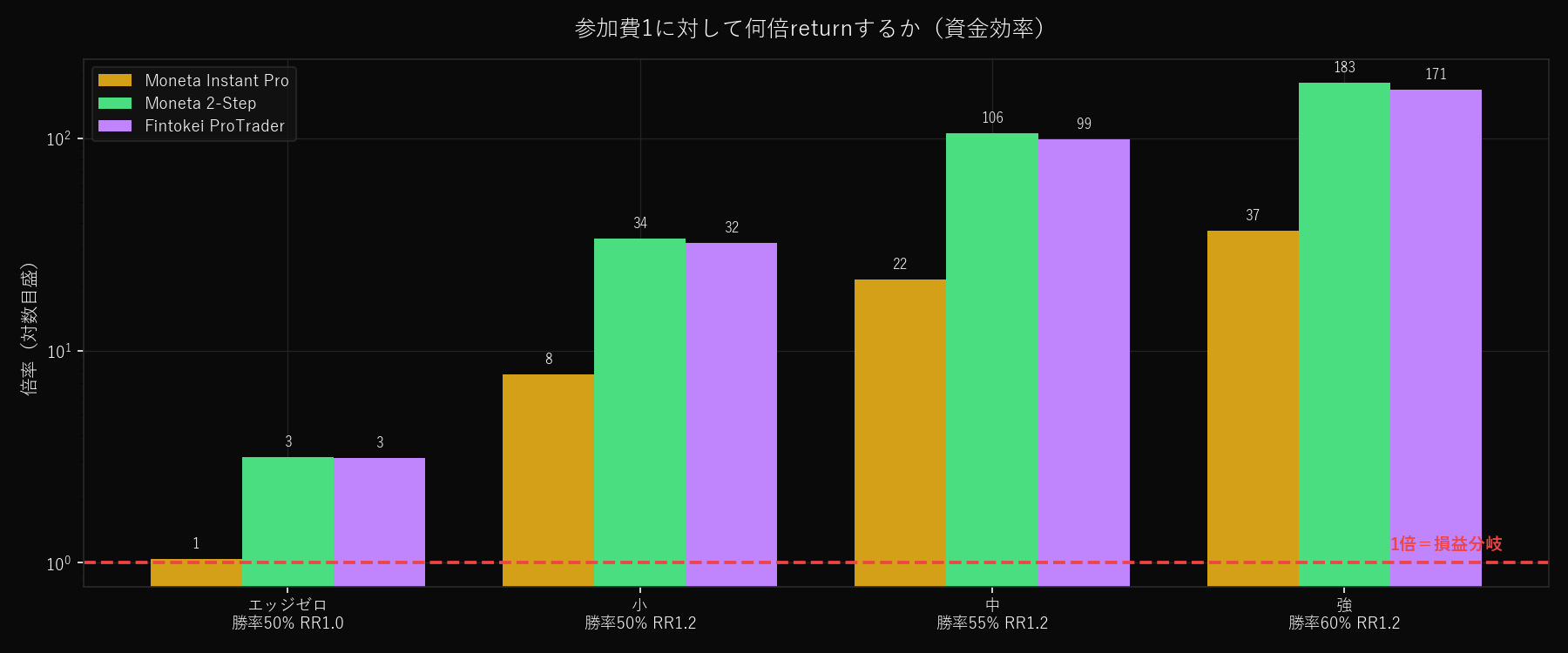
| Program | Fee | Reach funded | Days to reach | Max value | Net | Multiple |
|---|---|---|---|---|---|---|
| Moneta Instant Pro | 2.650% | 100% | Day 1 | 2.755% | +0.105% | 1.04x |
| Moneta 2-Step | 0.475% | 32.4% | 45 days | 1.492% | +1.017% | 3.14x |
| Fintokei ProTrader | 0.467% | 34.3% | 41 days | 1.452% | +0.985% | 3.11x |
The two-phase programs win decisively on efficiency even though only about a third of traders pass, because the fee is under a fifth as much. Moneta 2-Step and Fintokei are nearly even — net gain of +1.017% vs. +0.985%, multiple of 3.14x vs. 3.11x. Fintokei has both a higher pass-through rate (34.3% vs. 32.4%) and reaches funded 4 days sooner (41 days vs. 45 days), while Moneta's 88% split pulls the final payout slightly ahead.
For a trader with an edge
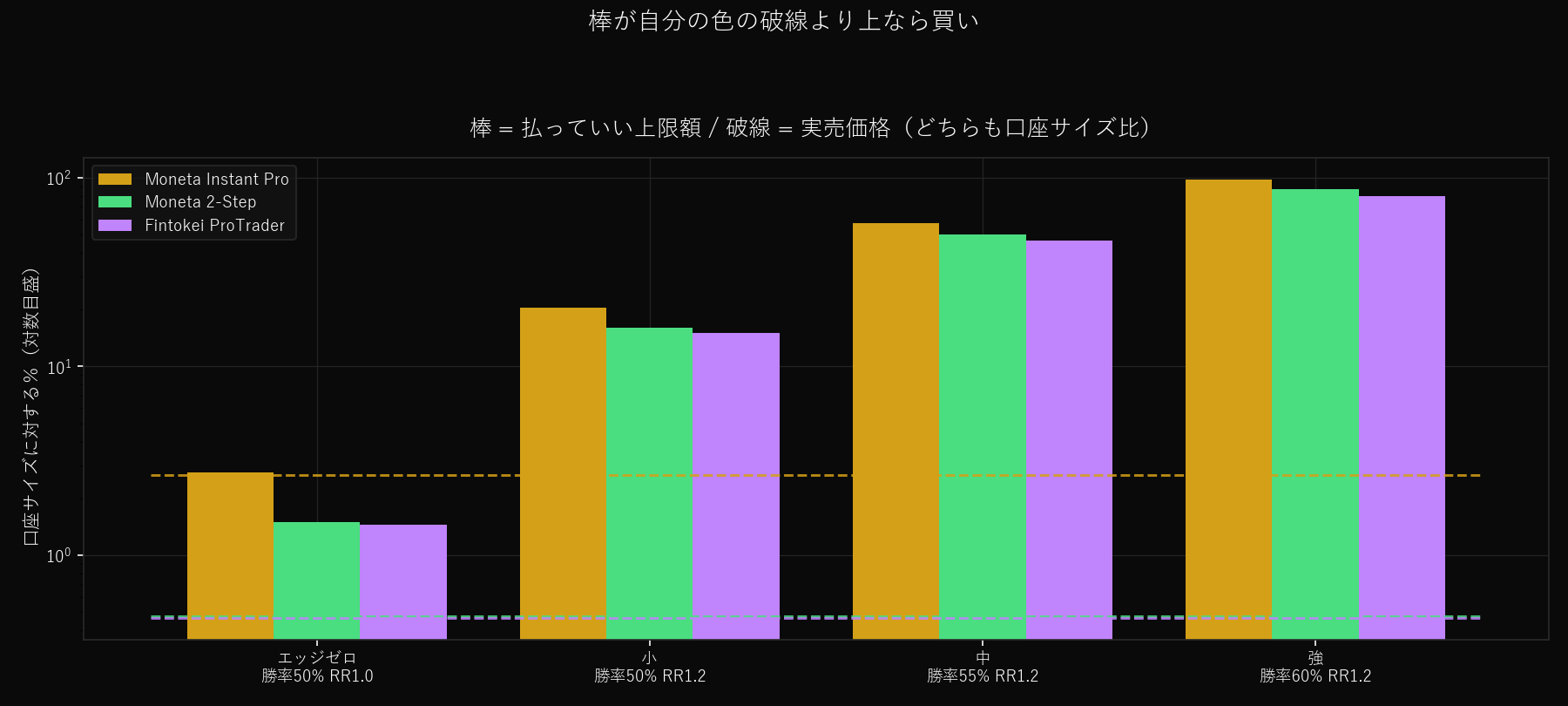
Push win rate to 60% / RR1.2, and:
| Program | Max value | Net | Multiple |
|---|---|---|---|
| Moneta Instant Pro | 97.4% | +94.8% | 37x |
| Moneta 2-Step | 86.7% | +86.3% | 183x |
| Fintokei ProTrader | 79.6% | +79.2% | 171x |
In absolute terms, Instant Pro is now the largest, because it uses all 120 trading days as a funded account, while the two-phase programs lose 16–17 days to evaluation. On the multiple, though, the two-phase programs are still about 5x more efficient.
In other words, the answer changes depending on what you're trying to maximize. If capital is limited and you want to run more attempts, choose the two-phase programs. If you have spare capital and want to buy time, choose Instant.
Moneta 2-Step vs. Fintokei
- The target structure is reversed. Moneta is 5%→10%, Fintokei is 8%→6%. Fintokei is front-loaded, Moneta is back-loaded. The totals are close (15% vs. 14%), but Moneta has a "10% in Phase 2" hurdle where failing sends you back to the start
- Fintokei's room is wider. 10% static + 5% daily vs. Moneta's cheaper configuration of 8% static + 4% daily. This is where the pass-through gap of 34.3% vs. 27.1% comes from
- Moneta's split is higher. 88% vs. 80% (Fintokei can rise to as much as 100% through loyalty)
- The 3% risk cap means different things even with the same number. Moneta's is a floating loss of 3% on the same symbol, triggering full close plus a same-day trading halt, then tightening to 1.5% afterward. Fintokei's is 3% on the combined total of all open positions, regardless of symbol or direction. Fintokei's is clearly stricter, so an EA holding multiple currency pairs at once needs to watch this closely
- Fintokei has no consistency rule by default. However, a "restriction rule" — best-day at withdrawal (a single day's profit under 40% of the total profit for the payout period) — can be discretionarily applied
- Watch the EA rules. Fintokei's plan page says "EA use OK," but the help center prohibits using a third-party or free EA someone else made, unmodified and untuned (a violation even if it's profitable). Self-made EAs, or ones you've tuned parameters on and understand the logic of, are fine. It isn't an option if your plan is to run an off-the-shelf EA as-is
- Fintokei is JPY-denominated with full Japanese support, and you can trade directly via TradingView. Martingale was removed from its list of banned practices on July 28, 2025
5. Conclusion
First: buying Instant Pro for the expected value is close to worthless. The maximum price worth paying is 2.755% of the account. At list price of 5.300%, the multiple is 0.52x — you're paying double the value. Even at the 50%-OFF price of 2.650%, it's finally a 1.04x fair trade. Add a 0.01% per-trade spread and it's 0.82x. You pay $2,650 and can expect $2,173. Even though it's technically positive on paper, once you factor in real trading costs it's closer to a losing proposition in practice.
Second: jumping on it because "it's half price" gets the order of reasoning backwards. Half price isn't a discount you're benefiting from — it's an item priced at double its value simply settling back to fair. A bigger discount just means the original pricing was more overpriced. What matters isn't the discount percentage — it's what the account is actually worth. Work out the max value first, then compare it to the price.
Third: if you're choosing by expected value, pick the two-phase programs. They return more than 3x on the fee, and win decisively on efficiency even with only about a 30% pass rate. This gap doesn't shrink as your edge grows. Putting the same budget into a two-phase program gives you a higher expected value at every skill level.
Fourth: if there's still a reason to buy Instant Pro, it's "time" alone. You're funded from day one and get the full 120 trading days. Not losing 16–45 days to evaluation makes the absolute amount the largest. But that's not a choice made on expected value — it's paying more than 5x for speed, and you should go in with that understanding.
Fifth: if you're going trailing, do it with a high-win-rate strategy. At the same 8%, a 30%-win-rate / RR3.0 strategy fails 23.7 points more often than static. Above 80% win rate, the gap nearly disappears. Buying Instant for a breakout-style strategy is the most expensive combination you could pick.
Sixth: clear the first +8% as fast as possible. 67–100% of failures happen before the lock. Once you're past it, the account becomes an ordinary static-DD account, so sizing down early to secure the lock makes logical sense against this rule set.
Seventh: if you size small, there's no point buying Instant. At 0.25% risk per trade, the account's value is $1,183 — clearly overpriced against $2,650. You'd be paying for drawdown room you never use.
Premises and limitations
- Spread, commission, and swap are not included in the core calculation. They're shown separately as a sensitivity check. Once real costs are included, Instant Pro's margin (0.105% of the account) disappears with just 0.01% per trade
- The same-symbol floating-loss trigger is not modeled (3% for Moneta, 3% for Fintokei). A discrete, trade-by-trade model can't represent the path of floating losses. In reality this trims the upper tail, so every program here is shown somewhat more favorably than it actually is
- Minimum trading days are not modeled (3 days per phase for Moneta 2-Step, 3 days for Fintokei). This is a real constraint for fast, short-run strategies
- This is a no-retry model. In reality you can buy again after failing, so the real-world expected value of the cheaper programs is somewhat better than shown
- Wins and losses are assumed independent. Real markets cluster losing streaks, so this is also more favorable than reality across the board
- Fintokei's profit-split increase via loyalty (up to 100%) is not modeled. Including it would improve Fintokei's numbers further
- Fintokei's 15% OFF is an assumed figure. Moneta's
TOKONATSU50(50% OFF) has been confirmed applied at checkout, but Fintokei has no standing 15% coupon. At the list price of ¥109,800 (0.549%), Fintokei's multiple drops from 3.11x to 2.64x. Even so, it's still far above Instant Pro's 1.04x - If the discount expires, the conclusion's premise changes. If Moneta's 50% OFF disappears, Instant Pro's fee becomes 5.300%, and the expected value turns fully negative (multiple of 0.52x against the 2.755% max value)
- Each firm's daily-loss threshold differs slightly (Moneta subtracts the daily loss amount from the day's starting balance basis on the initial capital's 4%; Fintokei uses 5% of the equity as of midnight that day). This model approximates it using the day's P&L
Scripts are available for download. sim-instant-pro-trailing.py (static vs. trailing comparison, max-value grid) and sim-phases-vs-instant.py (cross-program comparison). Both are Python + NumPy with a fixed random seed. Swap in your own win rate, RR, risk per trade, and trades per day to get the max value worth paying for your situation.
FAQ
Q. Why does the account have value even at zero expected value?
Because losses are capped and profit has no ceiling. All you can lose is the fee — no matter how much the account itself loses, you're never billed more. Meanwhile, a win is paid out at the profit split. This asymmetry is structurally the same as a call option, where the underlying's expected value can be zero while the option itself still has positive value. It helps to think of the prop firm's fee as the price of that option.
Q. What does "trailing locks at the initial balance" mean?
It means the DD line keeps rising only until it catches up to the initial balance. For a $100K account, the line starts at $92,000 and rises to "peak equity − 8%" every time equity makes a new high. Once equity touches $108,000, the line becomes $100,000 and stops there permanently. No matter how far you stretch afterward, the line doesn't move again.
Q. Why is a low-win-rate, high-RR strategy at a disadvantage?
Because what gets judged isn't the expected value — it's how choppy the path to it is. A 30%-win-rate strategy goes through long losing streaks before a winner arrives, and those streaks eat into the distance from the DD line. Meanwhile, a big win, before the lock is reached, only pushes the DD line up — it doesn't buy you more room against the next losing streak. Since the floor rises exactly as much as you climb, a high-variance strategy gets killed by its own variance.
Q. Is it still worth buying the two-phase programs if the pass rate is only 30%?
Yes, because the fee is under a fifth as much. Even for a zero-edge trader, passing 1 time in 3 means the expected payout at the funded stage is 3x the fee. "Low pass rate" doesn't mean "a loss" — look at the ratio between pass rate and price. Instant Pro has a 100% pass rate (obviously, since there's no evaluation), yet its multiple is only 1.04x.
Q. Which should I choose, Fintokei or Moneta 2-Step?
They're nearly even. The post-discount fee is 0.475% vs. 0.467%, DD is 10% static for both, and daily loss is 5% for both — the conditions are almost identical. There are only two differences. The target structure: Moneta is 5%→10% (back-loaded) vs. Fintokei's 8%→6% (front-loaded), and Fintokei reaches funded 4 days sooner with a higher pass-through rate (34.3% vs. 32.4%). The other is the profit split — Moneta 88% vs. Fintokei 80%. Those 8 points tip the final payout slightly in Moneta's favor (net +1.017% vs. +0.985%).
Beyond the numbers, it comes down to: if you need JPY billing, Japanese support, and TradingView integration, go with Fintokei. Neither works if your plan is to run an off-the-shelf EA as-is — Moneta requires a self-made EA, and Fintokei explicitly bans "using someone else's EA without adjustment" too. An EA that holds multiple positions simultaneously is more likely to pass with Moneta, since Fintokei's 3% applies to the combined total of all positions.
Q. Is sizing down early effective?
Against this specific rule set, yes, logically. Most failures happen before the lock is reached, and once locked, the account effectively becomes static DD with more room. That said, this article models fixed lot sizing, so the edge of variable sizing hasn't been tested. You can try it by modifying the distributed script.
Related articles
Written by
Hosono P | the prop firm strategist
I buy challenges with my own money and record everything through to the payout. Recorded payouts: ¥6.1M in total from Fintokei, Fundora and Funded7, plus $4,776 from The5ers (as of September 2026). Author of the semi-discretionary EA "ELDRA".